
Are we dating?
[a copyeditorial thought as another year crawls to its conclusion]

Merrily rereading a book I proofread decades ago, at the dawn of my career (so far I’ve taken note of but a single error, a “whom” that needs a “to” in front of it, so I’m retroactively patting myself on my retroactive back for a job well done), I’m reminded (I’ve just concluded a chapter about an excursion to view ancient Roman ruins) that in the written representation of years, one sets the B.C. after the year and the A.D. before the year, the B.C. standing for “Before Christ,” as I probably don’t need to tell you, and the A.D. standing for “Anno Domini,” which is to say “In The Year Of The [or Our, if you prefer] Lord” (which is why it precedes the date, and of course you would not then say “in the year A.D. 27,” or what have you, because that would be redundant, repetitive, and perhaps even tautological).
If you are not a Christian or are otherwise The (or Our) Lord–averse1 in your written representation of years, you can certainly opt, as some writers do, for the newerfangled system of B.C.E. (“Before the Common Era,” or some say “Current”) and C.E. (you got this).
As a longtime copy editor, production editor, copy chief, etc., in what is called trade publishing (i.e.,2 nonacademic publishing), I have seen the B.C./A.D. system used, persistently, by writers far more than the B.C.E./C.E. system, though I’ve been repeatedly assured that the former system will die out any second now (along with the word “whom” and the use of the subjunctive, and I just know that the United States will go metric momentarily,3 I can feel it!).
As a longtime copy editor, production editor, copy chief, etc., I also have never thought it my responsibility to urge4 B.C./A.D.–using5 writers to modern up and make the change to the B.C.E./C.E. system. At some point one has to believe—as difficult as it can be sometimes—that writers know what they’re doing. Or at least that they know what they want.
To be honest, I’ve always found, all the way back to first seeing it used in Hebrew school history books, the B.C.E/C.E. system irksomely euphemistic: One is still, after all, following the dating system devised to register the birth of Jesus; one is simply calling it slightly something else. YM, as they say, MV. I occupy, in this rare regard, a copyeditorially judgment-free zone.6
For either system, one can set, as I have done above, periods7 after each letter, or one can modern up and drop them.
The really fun thing, though, is to set those letters not in full caps, as I have done above, but in pony-size small caps,8 which, because I can’t figure out how to make them appear here in this ’stack, I am perforce9 showing you here:
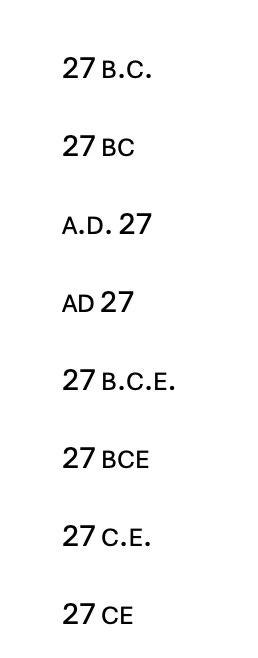
Note how cute and bonsai-like those small caps are.
How do you make small caps happen? Well, if you’re typing in Microsoft Word on a Mac, as I am wont to do, you’d start out with standard lowercase letters (as in, say, 27 b.c.), highlight the b.c. part, hop up top to Format, click on Font, and then choose, under Effects, Small caps.10
(Or you can type the b.c., highlight the letters, and then do Command-Shift-K, as I was just reminded by a reader with a memory sharper than mine seems to be these days.)
Either way, that looks like a lot of work, doesn’t it. OK, you can just type b.c. or B.C. and let someone else monkey with it later.
I might be good for another entry in the next week or so, so I’ll hold off on the usual end-of-year end-of-yearing. And, no, I won’t be supplying a Top Ten Copyeditorial Glitches in Christmas Movies or some such list. Sorry.
In the meantime:
Thank you for dropping by. Thank you particularly if you’re a subscriber to this series, and of course thank you especially if you’re a paying subscriber—that’s above and beyond, and I’m grateful.11
Benjamin
That charming abbreviation, i.e., is short for the Latin “id est,” i.e., “that is.” Which is to say: “that is to say.” It should not be confused with the equally charming abbreviation e.g., which stands for “exempli gratia,” i.e., “for example.” One always, wielding them, follows i.e. or e.g. with a comma, don’t necessarily ask me why. (It’s a tradition!, he exclaimed Zero Mostelily.)
Any moment now, that is, for you folk who use “momentarily” solely to mean “for a moment.”
I use the word “urge” precisely, pointedly, and carefully. One can urge writers to do any number of things; one can’t force them to do anything. More’s, sometimes, the pity.
En dash alert!
It must have been with a sense of great anticipation that people inhabiting the last decades of the B.C. (or B.C.E.) system lived their lives, wondering what epoch-making event was about to occur as they counted down to 1, though surely it was disconcerting to live one’s life backward.
That there was never a year 0, by the way, is why centuries begin in the 1 year and conclude in the 00 year. As much as it was a blast, then, to watch the calendar change from 1999 to 2000, one still had a year to go before the twentieth century finally collapsed of justified exhaustion and the twenty-first century began on January 1, 2001 (or 1 January 2001, as most of the world would style it).
(Or are you the sort of person who likes to call Frankenstein’s monster “Frankenstein”?)
This might also be a good moment for me to remind you that as you celebrate your, say, fiftieth birthday, you are not, as many people would say, commencing your fiftieth year; you are commencing your fifty-first year.
That is to say: full stops. Look, Ma, I’m bilingual.
If you want to be one of the cool kids, call full-size capital letters “full caps” and the smaller capital letters “small caps.” (I almost just wrote “smaller-size” to match “full-size,” but that would have been redundant, repetitive, and possibly even pleonastic.)
Perhaps we’ve covered this, but “perforce” is a marvelously pretentious word used to express necessity or inevitability. If you can get away with “albeit,” you can get away with “perforce.” The question, I suppose, is: Can you?
If you’re not typing in Microsoft Word on a Mac, I don’t know how to make them happen. Though occasionally, and perhaps this’ll work for you, when I need some sort of abstrusely accented non-Romance-language letter or a backward R or some such and don’t know how to type it myself, I seek it out online and then copy and paste it where I need it. Like, for instance, so: Я.
As is the Zen dog.

I commend your strength of character in resisting the temptation to say, “we’re just inches from going metric.”
Speaking of errors in previously edited/proofread books, a book I once edited was revised and given over to someone else for further proofreading, and when it was finally published, my name was spelled wrong in the Acknowledgments. Sigh.