
"awfully adjectival"
[a partway book report]

I’m making a happy journey through Thornton Wilder’s first novel, The Cabala (1926), which narrates a young American scholar’s adventures in Italy, particularly among the nearly eponymous cabal,1 “a kind of group living around Rome.” As they are first described to our so far unnamed protagonist: “They’re very rich and influential. Everyone’s afraid of them. Everybody suspects them of plots to overturn things.” The novel is, I read, semi-autobiographical, and it is written in a marvelously overheated hothouse lavender style2 that I might leap to describe as lapidary if lapidary were a word in my vocabulary, which it isn’t as I’m not a professional book reviewer; moreover, I had to go darting to the dictionary just now to look it up and remind myself of precisely what it even means.3
Here is my copy of The Cabala, which I would probably not be reading but for the fact that my sister happened upon it not so long ago in an antique shop4 in Brunswick, Maine, and generously purchased it for and posted it to me:
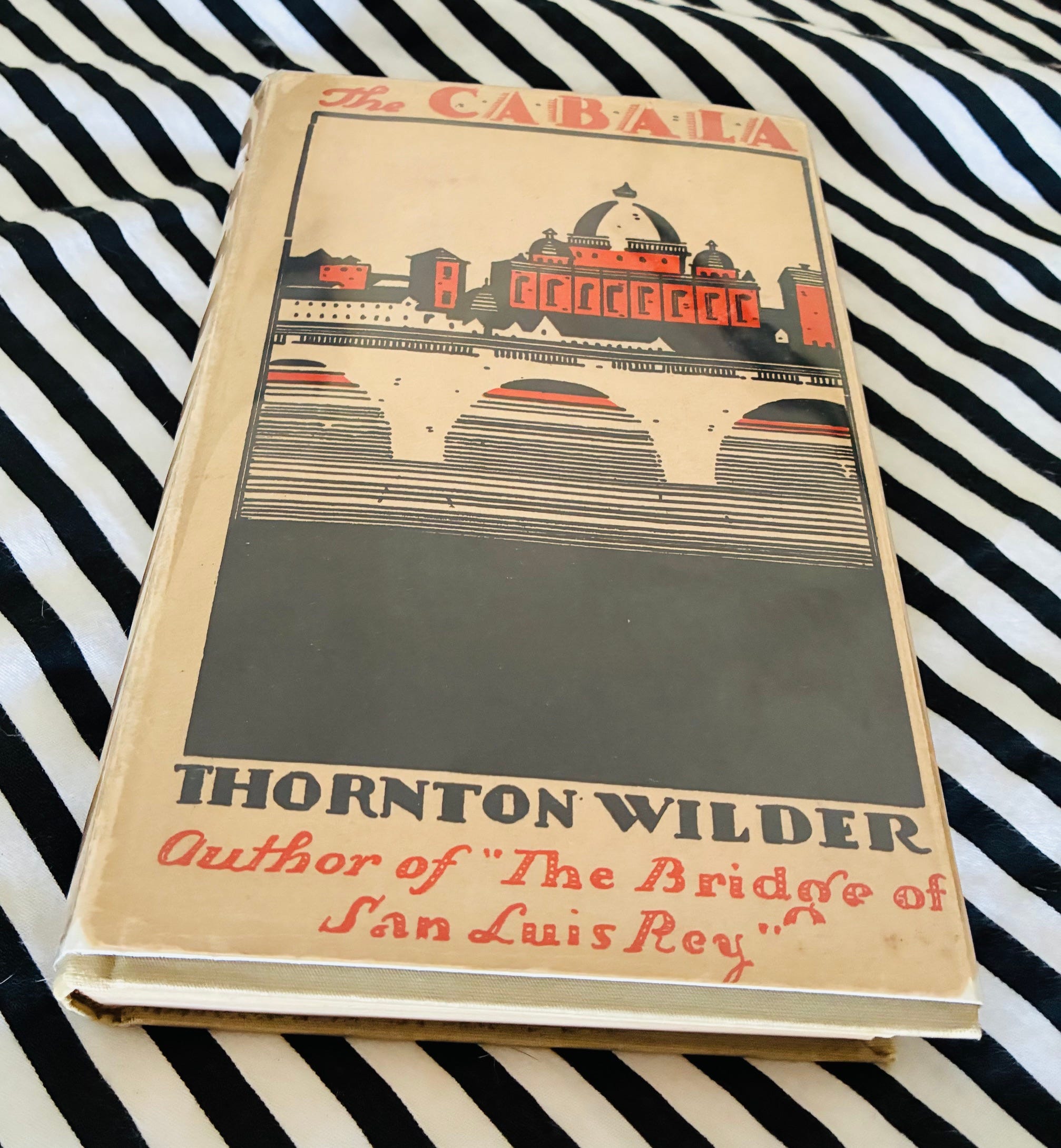
We note for a start that its jacket—my copy is from the August 1928 tenth printing; thank you, informative copyright page—gives a shoutout to Wilder’s second novel, The Bridge of San Luis Rey (1927), indicating that Wilder’s publisher, Albert & Charles Boni, Inc., was not unmindful of the huge success of The Bridge, as one of my Wilder devotee friends tends to refer to it, which sold a skillion copies and won the Pulitzer Prize, and knew the value of a good cross-sell, even a retroactive one, in case you thought that the canny, cunning commercial exploitation of literature was something invented only in the last five years or so.
In any event, so far (it’s not terribly long, but I’m not in a hurry) it’s a joy to read and frequently, surprisingly, hilarious, blackly or otherwise (surprising, that is, if you don’t tend to think of Thornton Wilder as hilarious), and I was especially taken with this one-two punch:
Punch one:
Say, do you mind if I drop in and see a friend of mine for a minute. If I’m going Tuesday I ought to say goodbye and see how he is. Do you hate sick people?
No.
He’s a nice fellow, but he hasn’t long to live. He’s published some verse in England; one of the thousand, you know. It got an awful rap. Maybe he’s quite a poet, but he can’t get over that diction. He’s awfully adjectival.5
And, a few pages later, punch two:
The poet was too sick to see us again and when I came back from the country he had died and his fame had begun to spread over the whole world.
As well, I wanted to share with you this majestic swath of a paragraph:
The Cardinal, though unimpaired in mind and body, looked all of his eighty years. The expression of dry serenity that never left his yellow face with its drooping moustache and pointed beard gave him the appearance of a Chinese sage that has lived a century. He was born of peasants on the plain between Milan and Como, and had begun his education at the hands of the local priests who soon discovered in him a veritable genius for latinity. He was passed upward from school to school gaining in his progress all the prizes the Jesuits had to offer.6 The attention of a large body of influential churchmen was gradually drawn to him and at the time of his graduation from the great college on the Piazza Santa Maria sopra Minerva (presenting a thesis of unparalleled brilliance and futility on the forty-two cases in which suicide is permissible and the twelve occasions on which a priest may take up arms without danger of homicide) a choice between three great careers was offered to him. The details of each had been prepared under the highest patronage: he might become a fashionable preacher; or one of the courtier-secretaries of the Vatican; or a learned teacher and disputant. To the amazement and grief of his professors he suddenly announced his intention of following a road that to them meant ruin; he declared for Missions. His foster-fathers raged and wept and called on heaven to witness his ingratitude; but the boy would hear of nothing less than the Church’s most dangerous post in Western China. Thither in due time he departed with scarcely a blessing from his teachers who had already turned their attention to more docile if less brilliant pupils. Through fire, famine, riots, and even torture, the young priest labored for twenty-five years in the province of Sze-chuen. This missionary fever however did not entirely spring from piety. The boy, conscious of the great powers raging within him, had been throughout his youth insolent, contemptuous of his teachers and of his companions. He knew and despised every type of a churchman to be found in Italy; never had he seen a thing adequately done by them, and now he dreamed of a field of work where he would be answerable to no fool. In the whole realm of the Church there was only one region that filled his requirements; a month’s travelling by crude wagon separates one from the next priest in Sze-chuen. There, then, after a shipwreck, some months of slavery, and other experiences that he never related, but which reached the world from his native helpers, he settled in an inn, dressed as a native, grew a pigtail, and lived among the villagers for six years without mentioning his faith. He passed the time studying the language, the classics, the manners, ingratiating himself with the officials and so perfectly identifying himself with the daily life of the city that in time he all but lost the odor of foreignness. When at last he began to declare his mission to those merchants and officials in whose homes he had become an almost nightly visitor his work was rapid. Perhaps the greatest of all the Church’s missionaries since the Middle Age, he turned many a compromise that was destined to shock Rome profoundly. He somehow achieved a harmonization of Christianity and the religions and accepted ideas of China that had its parallel only in those daring readings that Paul discovered in his Palestinian cult. So subtle were the priest’s adaptations that it never occurred to his first converts to be even conscious of repudiating their old faith until at last after twenty lectures he showed them how far they had gone and how charred were the bridges that lay behind them. Once he had them baptized however, he could give them only the bitterest bread to eat: the foundations of his cathedral lay squarely on a score of martyrs’ graves, but once built suffered no further assault and grew slowly and irresistibly. Finally sheer statistics did what envy could not prevent and he was made a bishop. At the end of his fifteenth year in the East he returned to Rome for the first time and was received with cold dislike. His health had been partly undermined, and he was granted a year’s repose, during which he worked in the Vatican library on a thesis relative to nothing in China, the donation of Constantine. This was considered shocking in a missionary and when it was published its learning and impersonality won it the neglect of the ecclesiastical reviewers. He was treated with condescension by the courtiers of the Palace; by implication they described to him their idea of his great creation in Western China: a low mud-brick meeting-house and a congregation of beggars who pretended to a conversion in order to be fed. He did not trouble to describe to them the stone cathedral with two awkward but lofty towers, the vast porch, the schools and library and hospital; the processions on Feast days carrying garish but ardent banners entering the great cavern of the Church and singing the correctest Gregorian; nor of the governmental honors, the tax-exemptions, the military respect during revolutions, the co-operation of the city.
Today is not Copyedit the Classics Day, so I’m not going to actually do anything with or to this barnburner. I simply wanted you to read it and, perhaps, get as big a kick out of it as I’ve just done. (And, OK, do please revel in its use of the word “correctest.”)
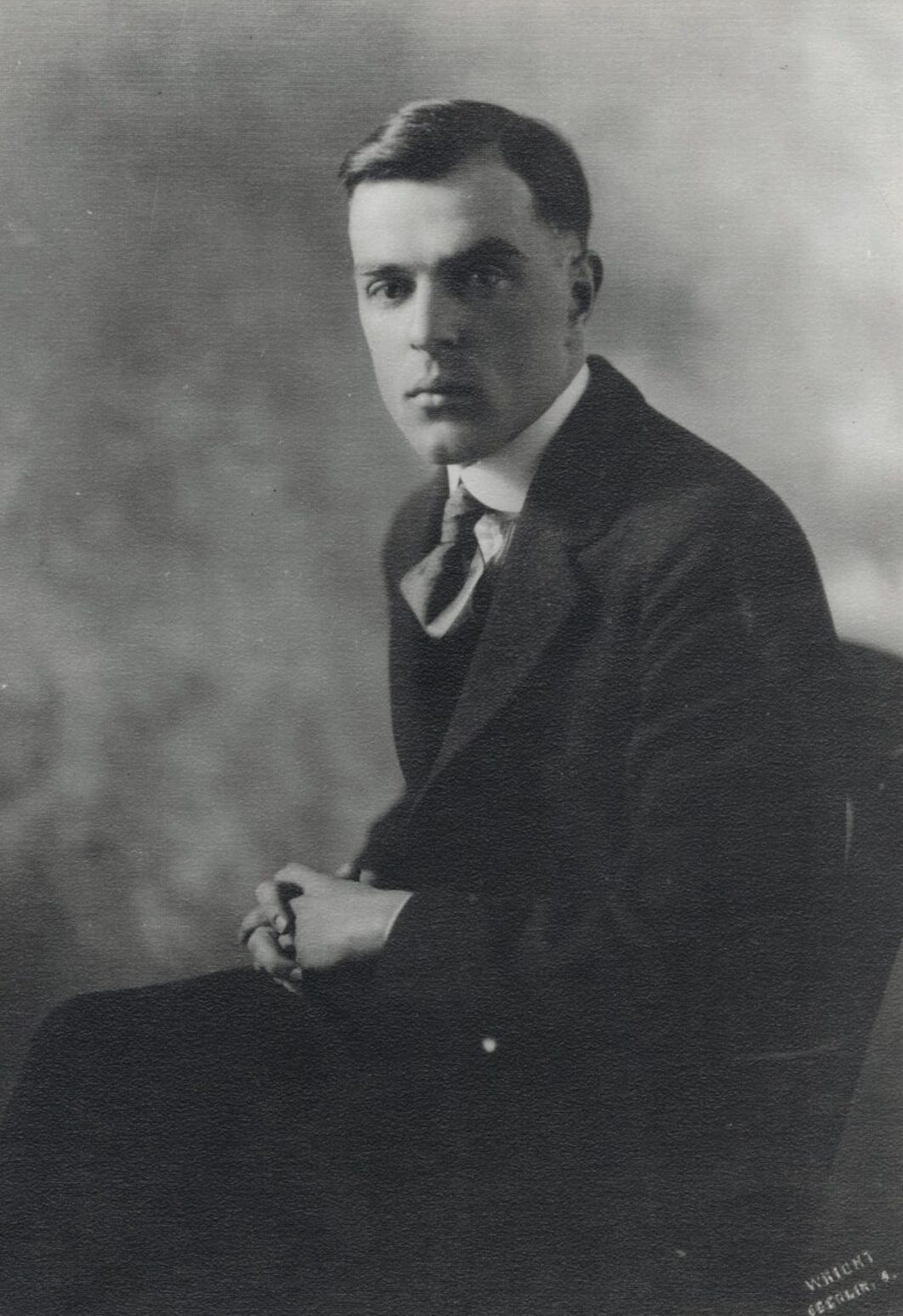
Oh, and: Here’s a photograph of young Thornton Wilder, taken I think around 1915.
My goodness.
Back to my reading, and if I have anything insightful or even simply amusing to say about the rest of The Cabala, I will not be shy about darting back here and sharing it with you.
To be continued,
B.
P.S. For you admirers of Elizabeth Taylor—whom one must always, I suspect, refer to, at least on first mention, as “no, I don’t mean the actress; I mean the writer”—my next read is apt to be Mrs. Palfrey at the Claremont, two of whose dramatizations—the 2005 theatrical release starring Joan Plowright, which I watched first, and the 1973 telefilm starring Celia Johnson, which I watched second—I’ve just met for the first time, and I’m eager to get to the source material to help me solve a little puzzle of a throwaway overlap between the versions that caught my eye. More on that as my copy arrives.
(And as I read it.)
(I’m not sure I’ve ever read Taylor. A friend who admires her hugely suggests that Mrs. Palfrey is her best work.)
Thank you for reading and hanging out with me. I extend my gratitude to those of you who’ve subscribed to this A Word About . . . series, and I extend particular thanks to those of you who’ve volunteered to become paying subscribers with no greater practical reward than the ability to comment in the comments.7 Your support and generosity mean a lot to me, on multiple levels.
Sallie is also grateful.
From our friends at Merriam-Webster:
Cabal has been associated with a group of five ministers in the government of England’s King Charles II. The initial letters of the names or titles of those men (Clifford, Arlington, Buckingham, Ashley, and Lauderdale) spelled cabal, and they have been collectively dubbed as the “Cabal Cabinet” or “Cabal Ministry.” But these five names are not the source of the word cabal, which was in use decades before Charles II ascended the throne. The term traces back to cabbala, the Medieval Latin name for the Kabbalah, a traditional system of esoteric Jewish mysticism. Latin borrowed Cabbala from the Hebrew qabbālāh, meaning “received or traditional lore.”
—In case you had even an iota of a scintilla of a doubt that our language is rooted in esoteric peculiarities and coincidences and is, overwhelmingly, nutso.
Yes, I think it’s gay. I think it’s very, very, very gay.
I figured it must have some relationship to lapis, and I figured right. Again, from our friends at Merriam-Wesbster:
The Latin word for “stone” is lapis, which rock hounds and jewelry lovers may be familiar with as the term for a semi-precious, deep blue gem also known as lapis lazuli, or “stone of the sky.” In the 1300s, lapis lent its shine to the English noun lapidary, referring to a cutter, polisher, or engraver of precious stones, as well as to the art of such a person. The crystalline refinement involved in the work of a lapidary eventually led, centuries later, to the use of lapidary as an adjective describing things that have the elegance and precision of inscriptions carved in stone monuments. Today it is used most often to characterize speech or prose (such as an essay, memoir, or address) that is considered notably clear and fine, but lapidary can also describe virtues such as grace and dignity, whether observed in one’s language or character.
Not as lunatic as the cabal thing, but, still, fun. Like, “stone of the sky”? Seriously? I love that.
Also, on my way to looking up “lapidary” I ran into “cabochon,” which is also a spectacular word.
For a long time I said “antiques shop,” with the desire to be crystal clear that the shop in question sold antiques but was not itself antique, and then at some point I stopped doing that.
Wilder doesn’t, throughout, use quotation marks for his dialogue. Another thing that wasn’t invented in the last five years or so.
Certainly those are the two gayest sentences I’m going to read today.
Which is where the fun happens.
Ah, love the “latinity”!
As a metalsmith who uses cabochons in my jewelry designs, and is also a member of my local Lapidary Society, I'm so glad you came across those words and found them interesting! I'm more partial to the translucent stones like aquamarine and amethyst, or the iridescent opals, but lapis lazuli is a beautiful color too. And I love that the adjective "lapidary" can be used to describe writing, I have not seen that before, I'm going to have to find a way to use it.