
"isn't life—"
[an epilogue]

Thank you again for stringing along with me during this just-concluded “Garden Party” adventure. As promised, I will certainly return in a few days, after I’ve let my brain cool down a bit, with my daydream of a post-copyedited version of the story. To quote myself:
I [intend to] repost the entire story, sans commentary, reflecting my edits and queries as I fantasize that [Katherine] Mansfield might have responded to them and signed off on them, the goal being that you will all find the story as thrilling as I presume you did when you read it in its original form, that you might feel some unnameable,1 inchoate frisson of “Gosh, this is even better than I recalled, how did that happen?,” and that you will 100 percent not detect my fingerprints anywhere. For that is, as I’ve often said, the goal of copyediting: to make a piece of text into the best possible version of itself that it can be.
Many of you have already provided keen insights based on your own readings of the story, and I will certainly take those into account as I prepare my (light, I assure you!) revision.
I’d also, realizing that I’d never to my knowledge/recollection read anything else of Mansfield’s, decided to pick out one other story from The Garden Party and Other Stories, simply to see if it might work the same sort of magic on me. The story I selected, more or less at random and simply because the title appealed, was “The Singing Lesson,” which proved to be a mere slip of a sketch, a little ominous, a little funny (with one particularly blackhearted line that made me laugh literally out loud), and quite, quite exquisite. At this point, then, I suspect I’m going to make eventual time to read everything of Mansfield’s I can get my hands on, but other assignments compel me first.
A funny thing: Between selecting “The Singing Lesson” and reading it, I found myself listening to, among other things, Carousel’s “Blow High, Blow Low” (specifically from the 2018 Broadway revival cast recording), and my attention was piqued by the reference to “a chrysanthemum spout com[ing] out o’ the snout of a whale!,” and somehow the word “chrysanthemum” kept dancing around in my skull, in part because it has an odd and pleasing sound and spelling, and in part because the only other Broadway2 lyric I could think of that includes it is that ode to maternal filicide “Chrysanthemum Tea,” from Pacific Overtures (“if the tea the Shogun drank will / serve to keep the Shogun tranquil”: that’s the good stuff, Steve). Anyway . . .
Imagine my delight, reading “The Singing Lesson,” to happen upon:
And Mary Beazley, who was waiting for this moment, bent forward; her curls fell over her cheeks while she breathed,3 “Good morning, Miss Meadows,” and she motioned towards rather than handed to her mistress a beautiful yellow chrysanthemum.
I mean, what are the odds?
Thank you, once again, to all readers, with particular thanks to those of you who have subscribed to this A Word About . . . series, and to those of you who have chosen to become paying subscribers with no more compelling tangible reward than the ability to comment in the comments, I extend even more particular thanks. Your support means a lot to me, on all sorts of levels.
A dreamy dog thanks you as well.

By the bye, the four-part copyediting seminar I taught last year for the wonderful folks at StoryStudio Chicago is now available on demand, and (as I recall) it’s equal parts amusing and helpfully instructive, so perhaps you’ll want to check it out.
Also, lest we forget, caps.


Not having manufactured and hand-embroidered them myself, I’m allowed, I think, to say that I’m hugely pleased with how they’ve turned out. The caps themselves are solidly well constructed, with a jaunty strap-and-buckle thing going on in the back, and the lettering is chef’s-kiss clear.
Also, that’s not red. It’s cranberry.
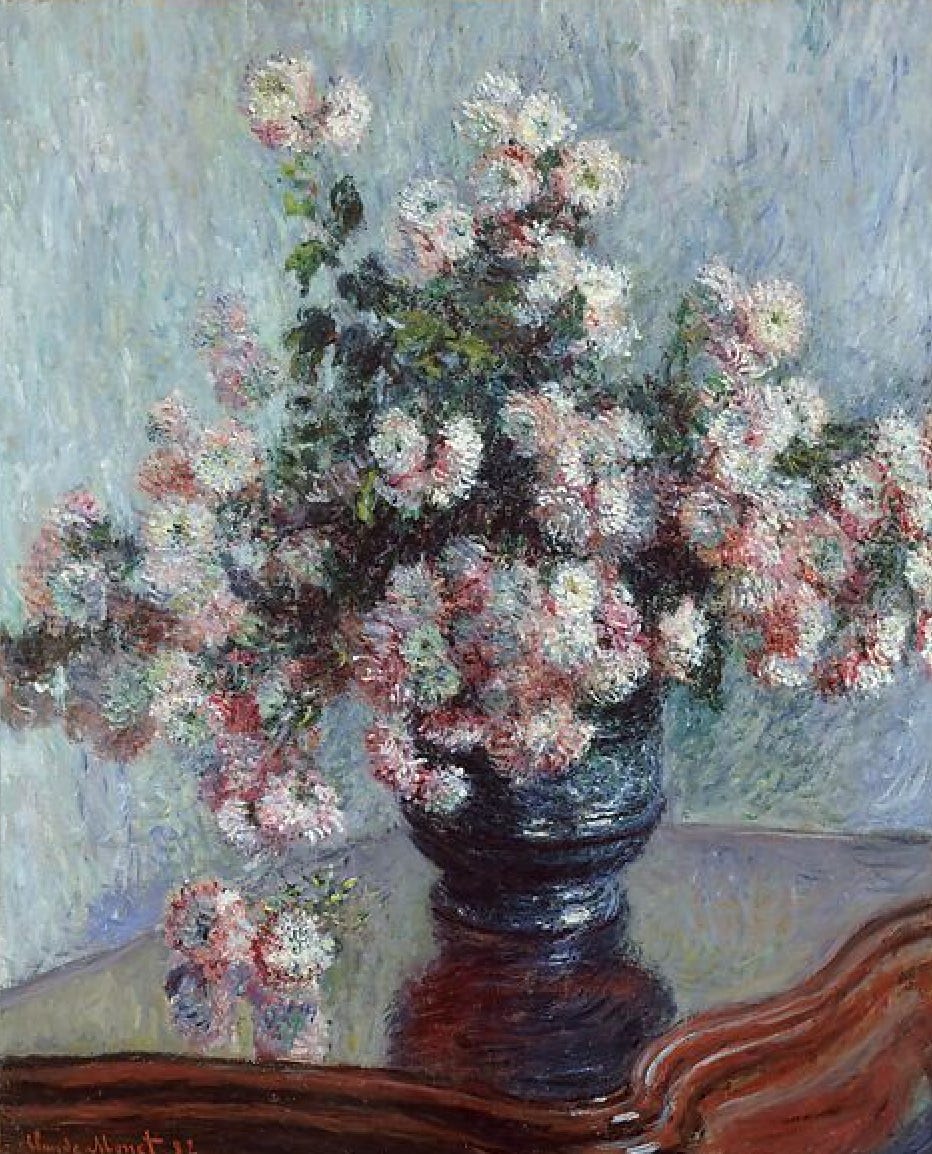
Cover illustration: Claude Monet, Chrysanthemums (1882), Metropolitan Museum of Art, N.Y.C.
A recently notoriously rejected New York Times Spelling 🐝 pangram, I note. As was, that very day, “unmalleable.”
There is as well a whole-ass 1956 West End musical titled Chrysanthemum, which, I’ve just now learned, is the inspiration, for lack of a better term, for the movie (and eventual stage musical) Thoroughly Modern Millie.
Yes, I want to delete this comma.
Nor, I might add, did the NYT Spelling Bee accept caryatid. Tsk tsk.
Regarding Chrysanthemum, I was just recommending the picture book by that name to a friend. Author and illustrator, Kevin Henkes. One of the reasons it impressed me so completely was that the sound of the word is part of the rhythm of the story: the parents love the sound so much they give the name to their dear baby mouse, you see. I love a book for kids that shares a child's glorious delight in a new word, another aspect of the mystery of language. What a fun word.
Also, my house is now replete with Stet hats, one in each colour. Therefore I had to wear one to shul, and you'll be pleased to hear that my rabbi looked and said, "Sto, stare, steti, statum... But what is stet?" And now he knows.
The Mansfield exercise was a delight. So is my new "I am a copy editor" T-shirt. But despite its label, it is NOT khaki. It is a very dark shade of olive drab. You need to have a discussion with your Latvian providers. Or just change the catalog entry.