
quote unquote
[a brief reminder]

Yesterday afternoon over at Bluesky, I stumbled1 upon a highly amusing account of a court case gone very, very, very wrong when it turned out that “an assistant U.S. attorney in North Carolina . . . fabricated quotes and erroneous citations in an AI-produced court brief.”
One particular detail caught my eye and captured my imagination in the real-time live-posting2 of the case by an attorney named Randy Herman, specifically the benighted assistant U.S. attorney’s assertion that he had, in his brief, encased certain text in quotation marks “as a general statement of the case and not [as] actual quotation[s],” going on, having provided himself with good strong rope, to hang himself with “This was a writing technique to liven up the prose.”
But wait, there’s more: “The language in quotes was for emphasis,” the assistant U.S. attorney continued. “Obviously I did not do it correctly.”
You can, as they say, say that again.
A reminder re the basics:
When you are quoting someone else’s material (and we’re speaking here of standard-issue factual/journalistic/nonfiction sort of writing; what fiction writers get up to is their own business), you are obliged to encase that someone else’s material in quotation marks and to quote it verbatim. All interpolations must be encased in brackets (as I have done somewhat fussily above, to demonstrate the technique), and all interior deletions3 must be indicated by the use of ellipses.4
You are allowed, unless you’re traveling in extremely rigid legal or academic circles, to silently adjust capital letters at the beginning of a bit of quoted text to lowercase ones, and vicey versey, as it serves your overall text without the use of brackets, as, for instance, I allowed myself, above, in quoting the linked Bloomberg news story, which begins “An assistant U.S. attorney,” to write “an assistant U.S. attorney” and not “[a]n assistant U.S. attorney.” If you follow me, and I presume you do.5
What you do not do is encase paraphrased, much less entirely made-up, for the love of Gawd, material in quotation marks “for emphasis.”
That’s it for today.
Thanks for being here. Please feel free to subscribe to this series, which would please me no end, and if you’d care to become a paying subscriber you will have my undying gratitude plus the privilege of chitchatting in the comments.
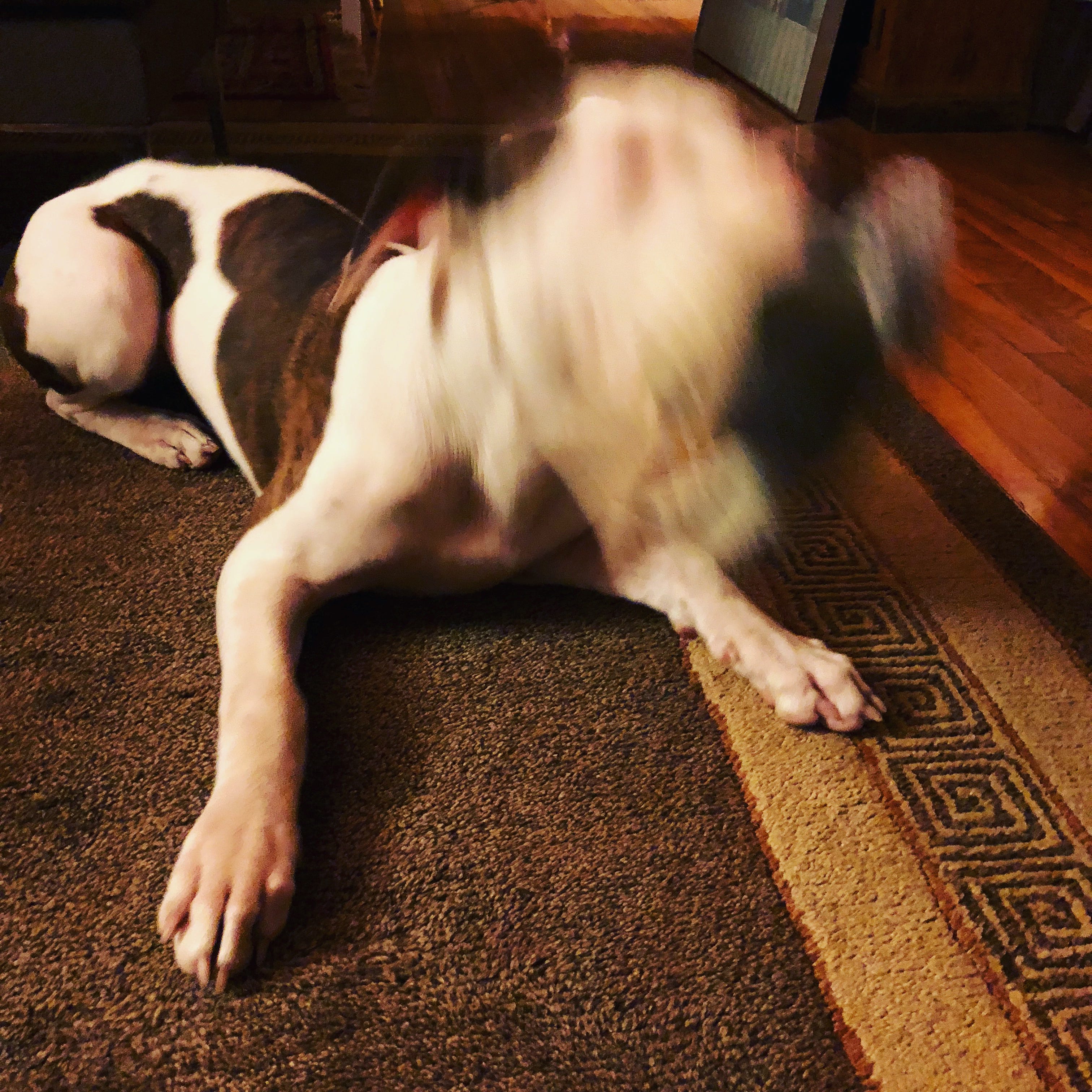
Here’s a vintage photograph of Sallie, from when she first came to live with us nearly a decade ago, doing her celebrated impression of a Francis Bacon painting.
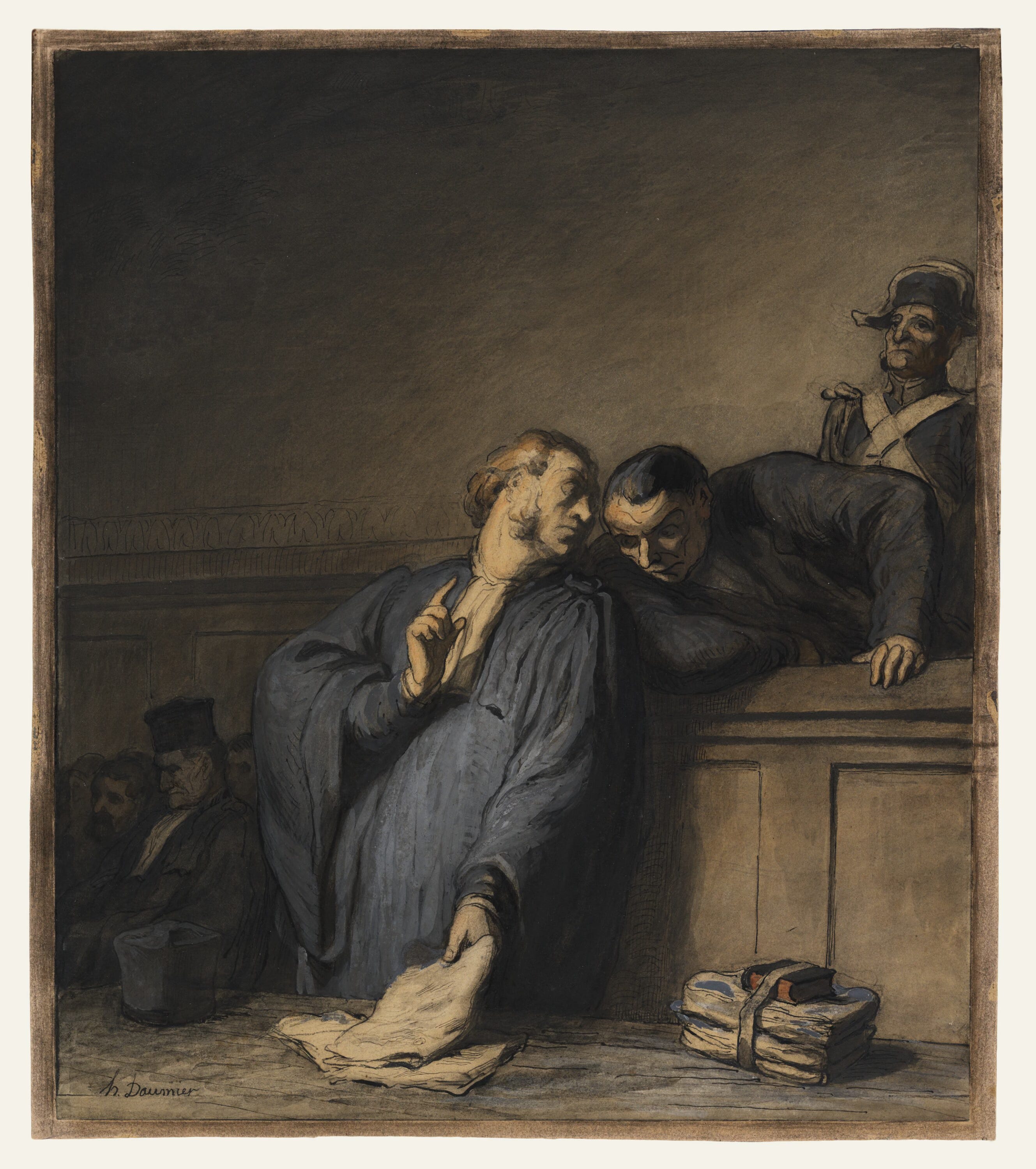
Cover image: Honoré Daumier, A Criminal Case (c. 1865) (watercolor and gouache6 with pen, brown ink, and black chalk) (J. Paul Getty Museum, Los Angeles)
Post-publication addendum for the latecomers: I’d originally written and posted that as “over at Bluesky I stumbled” and realized only after the fact that I was perhaps inspiring people to wonder about Bluesky II and Bluesky III. God bless commas!
Well, that’s a touch redundant, I guess.
That is, there is no need to begin a bit of quoted matter with ellipses or to conclude it with ellipses.
We can have, but not right this second, a separate discussion about works of nonfiction in which the author chooses to, say, regularize/modernize antique spelling in quoted matter, silently repair uninteresting errors, etc. The short version: An explanatory frontmatter note will take care of that nicely.
If you don’t, you’ll ask.
I can never see the word “gouache” without thinking of the dazzling 1985–86* London Weekend Television adaptation of E. F. Benson’s Mapp and Lucia novels starring Geraldine McEwan, Prunella Scales, and Nigel Hawthorne. If you’ve never had the pleasure, I can assure you that you will find great joy there. And if you have had the pleasure, then you know what I’m talking about.
*En dash alert!
I always feel smarter after reading one of your missives. Thanks for that! I've not been feeling too bright lately, what with current events and all, and I'm tired of saying "How in the world could THAT happen?" when it just did.
Why do I suspect you'll need to repost this on a regular basis? (Sigh.)
And now I think I might need an E.F. Benson fix.