
"Stop everything, Laura!"
[copyediting "The Garden Party," part 6]

[Today’s missive will include a number of footnotes—indeed, that’s its entire point and M.O.—so I remind you that you don’t have to violently scroll down and up and down and up to enjoy them; you can simply, depending on your particular reading gadget, hover over or click on the superscript numbers and the footnotes will make themselves available to you.]
Hello again. Scheherazade1 here.
I’ll leave you to find your way to the previous five installments of this series on your own, if/as you need to, because you’re all terribly clever people.
Let’s get cracking.
“Let’s go into the garden, out by the back way,” suggested Laura. “I want to see how the men are getting on with the marquee. They’re such awfully nice men.”
But the back door was blocked by cook,2 Sadie, Godber’s man3 and Hans.
Something had happened.
“Tuk-tuk-tuk,” clucked cook like an agitated hen. Sadie had her hand clapped to her cheek as though she had toothache.4 Hans’s5 face was screwed up in the effort to understand. Only Godber’s man6 seemed to be enjoying himself; it was his story.7
“What’s the matter? What’s happened?”8
“There’s been a horrible accident,” said Cook.9 “A man killed.”10
“A man killed! Where? How? When?”11
But Godber’s man wasn’t going to have his story snatched from under his very nose.12
“Know those little cottages just below here, miss13?” Know them? Of course, she knew them.14 “Well, there’s a young chap living there, name of Scott,15 a carter.16 His horse shied at a traction-engine, corner of Hawke Street this morning, and he was thrown out on the back of his head. Killed.”
“Dead!” Laura stared at Godber’s man.
“Dead when they picked him up,” said Godber’s man with relish. “They were taking the body home as I come17 up here.”18 And he said to the cook,19 “He’s left a wife and five little ones.”
“Jose, come here.” Laura caught hold of her sister’s sleeve and dragged her through the kitchen to the other side of the green baize door. There she paused and leaned20 against it. “Jose!” she said, horrified, “however are we going to stop everything?”
“Stop everything, Laura!” cried Jose in astonishment. “What do you mean?”
“Stop the garden-party, of course.” Why did Jose pretend?
But Jose was still more amazed. “Stop the garden-party? My dear Laura, don’t be so absurd. Of course we can’t do anything of the kind. Nobody expects us to. Don’t be so extravagant21.”
“But we can’t possibly have a garden-party with a man dead just outside the front gate.”
Well, we would certainly think we can’t.
Today’s a pretty, sunny Saturday here, and I hope it is where you are too. So I’d like to do a few pretty, sunny Saturday things and leave you to do the same.
I’ll be back on Monday or Tuesday, which probably means Monday.
Thanks again for your time and attention.
Greetings from Sallie.

It’s harder than you might think to type with one hand and rub a dog’s belly with the other. But needs must when the Devil drives, or however that goes.
Till later,
B.
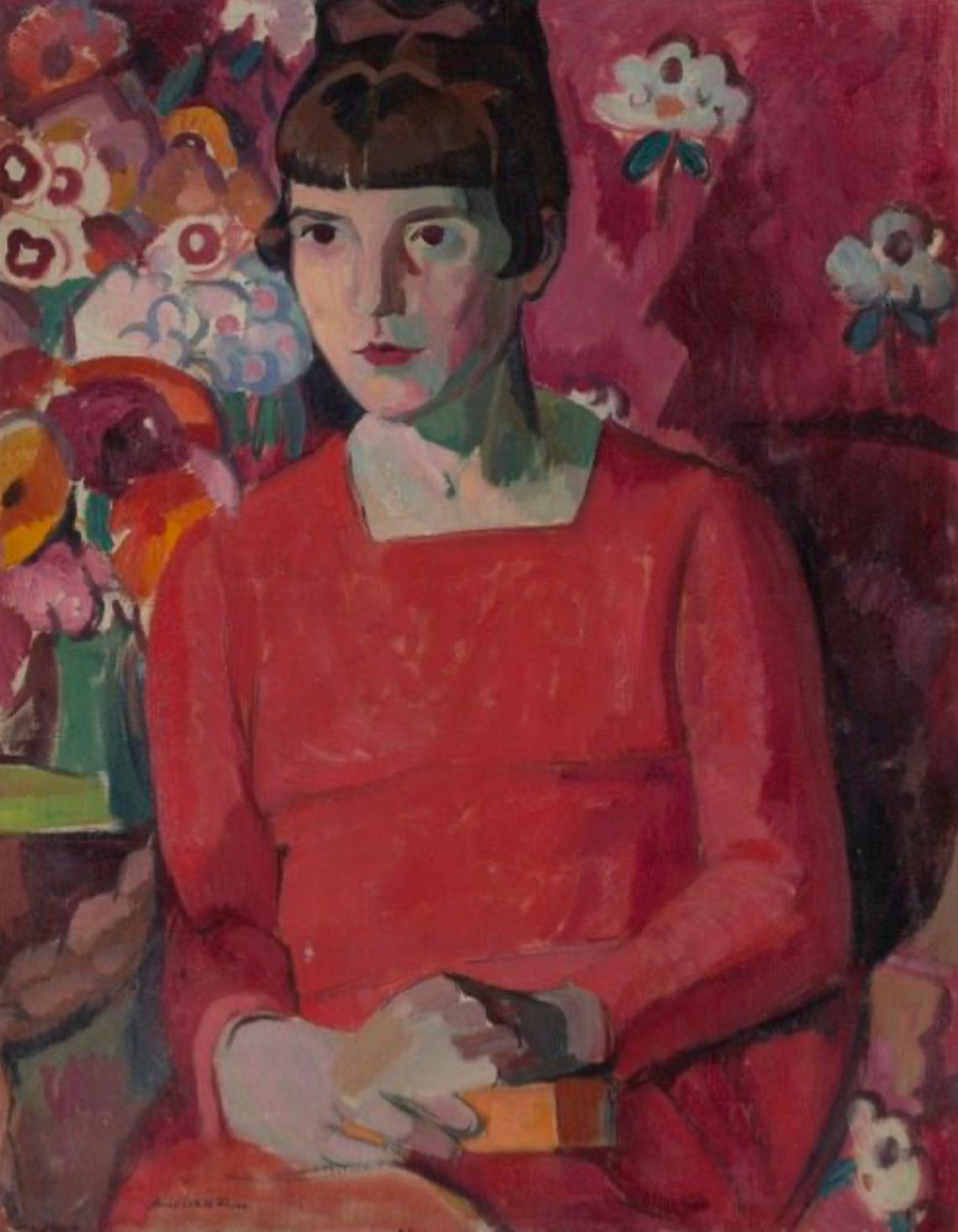
Cover illustration: Anne Estelle Rice, portrait of Katherine Mansfield (1918), oil on canvas (Museum of New Zealand/Te Papa Tongarewa)
Post-publication addendum: I have no idea how this piece managed to go out into the world, at least to its first recipients, with Sallie as the official cover illustration rather than Miss Mansfield, but Sallie’s an awfully attractive dog, so where’s, I say, the harm.
One of those names I don’t even type, much less publish, without looking them up (and, in this case, simply copying and pasting from a trusted source, because if I retype it I’m apt, more than apt, to screw it up).
Take note, please.
At the risk of repetition: comma.
We also note that Mansfield has named the man from Godber’s “Godber’s man.” Not, indeed, “the man from Godber’s” or even “the Godber’s man.” Just “Godber’s man.”
I might say that clapping one’s hand to one’s cheek in shock is a rather theatrical gesture, but I know I’ve done it myself more than a few times, entirely unselfconsciously, or at least as unselfconsciously as I ever do anything. If you want to see the best hand-to-cheek clap in cinematic history, I commend to you Linda Manz’s rendering—two-handed, as I recall—at an indeed shocking, and heartbreaking, though thoroughly inevitable moment in Terrence Malick’s 1978 film Days of Heaven.
I’m grateful that Mansfield has gone with “Hans’s” here, my possessive styling of choice. Had she not—had she gone with “Hans’”—I’d’ve slapped on an s, sans comment, and hoped for the best.
Our eyes are now wide open re consistency in this matter.
Oof. That’s cold.
We can infer, easily, that this is Laura speaking, so the absence of a speech tag is certainly A-OK with me.
Up to this point, the Sheridans’ cook has been repeatedly referred to as—as Mrs. Sheridan herself is called lowercase “mother” by her daughters—“cook.” (I’ve been wanting to call her Cook all along, he said, patting himself copyeditorially on the back.) And now she’s, indeed, Cook, at least per the Project Gutenberg text I’ve been using.
I went in search of something a bit more primary and archival and landed on the 1923 Knopf edition of The Garden Party and Other Stories (the first U.S. edition, fourth printing, for the record), and feast your eyes:
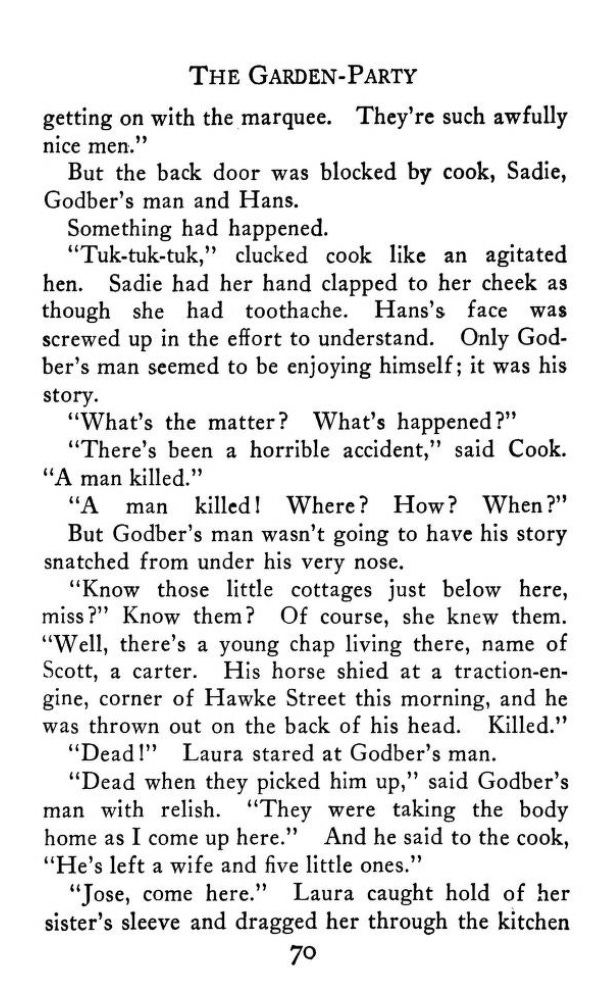
So we’ve landed on our first honest-to-God inarguable copyediting/proofreading lapse, and of course I’m quite fond of it, as I’m fond of all antique textual errors that prove, to the doubting Thomases, that typos aren’t an invention of the twenty-first century.
What would one do if one were preparing this story for inclusion in a new anthology? I suppose that one could go back and change all those previous “cook”s to “Cook”s, while also changing all those previous “mother”s to “Mother”s while we’re at it, but yikes, that feels more than a bit intrusive, plus a clear violation of authorial intent. One might also, quietly, and vastly more simply, lowercase this one to match the previous ones. (I’ve peeked ahead; there’s just one more “cook” to come, and we’re about to get to it, so sit tight a second.) Or one might simply leave everything alone and, if this were an anthology of the more scholarly sort, note the anomaly in the textual notes one is presumably setting in the back of the book.
When I first reread this story a couple of weeks ago for the first time in, as mentioned, over fifty years, this turn of events truly stunned me. A, I’d entirely forgotten where the story was going (obviously). B, we can go back to the start, as I would certainly do if I were actually copyediting this story and thus giving it two thorough reads, and look for foreshadowing. (Not as a copyeditorial matter, particularly, just out of curiosity.) I don’t think we’re going to find anything. You feel free to give it a go, though.
Again, it’s Laura.
Ice cold.
And the “miss” certainly underlines that the man from Godber’s—sorry, Godber’s man—is addressing Laura and not cook/Cook.
Again, Mansfield slides right into Laura’s mind without fuss, and, again, we find ourselves being asked to identify with/be Laura.
Another name to be noted on the style sheet. Also Hawke Street.
A carter is a person who drives a cart, often to deliver goods. You may have paused to look that up; it may be a word that’s already in your mind realm.
Indeed, “come,” not “came.” This is how he speaks. Not querying it, not even mentioning it.
We note—again, mostly as a matter of grisly curiosity—that Godber’s man managed to deliver up his cream puffs, handing them off to Sadie, and keep his trap shut till after, presumably, he’d gotten Sadie or cook/Cook to sign for them, before he got started gossiping.
She is referred to, once earlier, as “the cook” rather than “cook.” I didn’t particularly note it then, but I’d certainly, after all this tumult, be watchful, and I’d probably query it just to make sure that everything is as Mansfield would have it be. The earlier “the cook” was from Laura’s point of view; this one is via Godber’s man, who might naturally think of her as “the cook” rather than as “cook.” (I don’t mean to worry this all to death. It’s just something to take note of and succinctly/quietly call the author’s attention to. She’ll probably barely notice.)
I wouldn’t have been surprised to run into a good old-fashioned Brit “leant.”
That’s a marvelous word choice, given all the ways Jose might have characterized her sister’s impetuousness. It tells us something.
As my beloved Aunt Bert would have said, “Oy, such tsuris!”
Regarding footnote 10: It just occurred to me that Jose's maudlin art song could be considered foreshadowing. "Life is Wee-ary...then goodbye!" if I recall correctly.
Otherwise, up to this point the story's been about a "perfect" day, with "golden" light, "nice" workmen, and a "sweet" hat, even before the lilies and sugar-coated cream puffs arrive.
Those doom-filled lyrics were going to be Jose's opportunity to show off her delicate artistic sensitivity for the guests. If she performs them under the new circumstances, even without flashing her "brilliant, dreadfully unsympathetic smile," it'll be a mockery.
(That said, I admit that I don't know whether or not I'd cancel the party. I can't even envision these people's porch and kitchen, let alone how close the Scotts' house is, how much traffic there's going to be up the hill, or how far the band music would carry. In my neighborhood today it would be unusual for one household to stop a party because someone a few houses away had died. But I don't know the culture Laura is in. Maybe the party could go on, but not that song.)