
"What a horrible combination"
[copyediting "The Garden Party, part 5]

[Today’s missive will include quite a number of footnotes, so I remind you that you don’t have to violently scroll down and up and down and up to enjoy them; you can simply, depending on your particular reading gadget, hover over or click on the superscript numbers and the footnotes will make themselves available to you.]
A few previews before the main attraction.
I thought it might amuse you to know that I received the page proofs of my foreword to the University of Chicago Press republication of Sally Benson’s charming novel Meet Me in St. Louis, and having read my piece through three times I changed a single word,1 an act of highly uncharacteristic restraint on my part in part because I’d been asked/told to mind my manners and in much larger part because the editing and copyediting I’d been granted by the lovely folks at U of C Press were as attentive as a writer might wish.
Also, the book text has been beautifully designed and laid out, and I was pleased to see that each of my footnotes (nine pages of text, eight footnotes, that feels about right) was tidily contained on its relevant page, which, as I well know, can take some doing.
So: Big ups to everyone. (Including, if I may say so, me: It’s a nice little foreword, as you’ll see when you receive, later this year, the copy or copies you’ve preordered.)
Speaking of ordering things, I wouldn’t want you to have missed out on the newly available merch:


Two styles, three colors (the third is cranberry2), details here.
I am delighted to report that word of this “Garden Party” series has made its way to the home country—Katherine Mansfield’s, that is, not mine, which is Jackson Heights, Queens, N.Y., U. S. of A.—particularly to the Katherine Mansfield House & Garden itself. “We love it so much,” if they don’t mind my quoting them. How about that?
I’ve also come to realize how little (which is to say nothing) I’ve known about Katherine Mansfield. I didn’t even know what she looked like.
Behold!
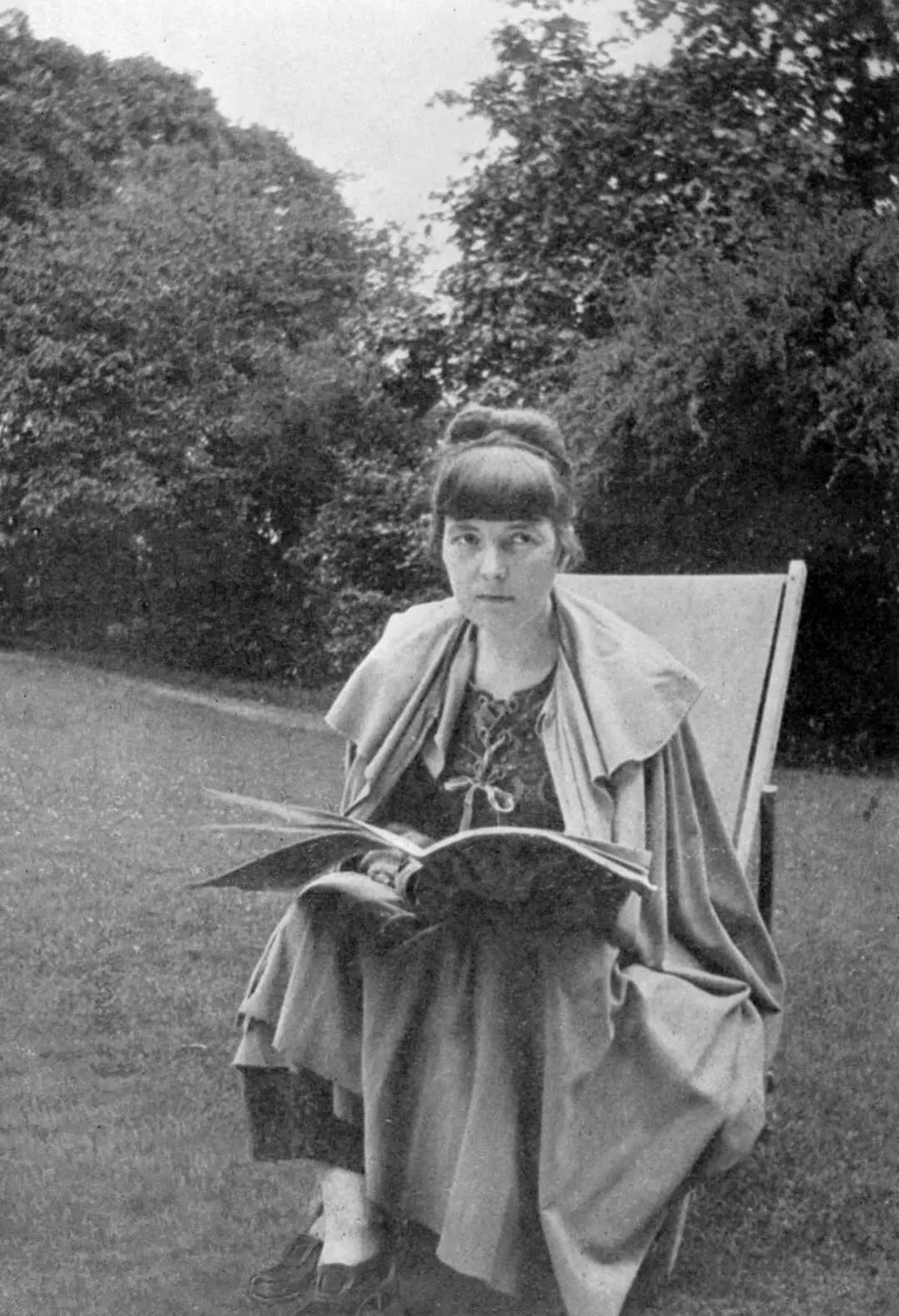
Enchanting, no?
I’ve also since read up on Mansfield via her helpful Wikipedia biography, which I’ll leave you to peruse for yourselves, because, my word, what an extraordinary life packed into, I was sad to learn, a mere thirty-four years.
To be sure, it’s not required to know anything about an author or their life before you copyedit their work—there’s a kind of purity to the copyediting process, really; it’s just you and a bunch of words—but ultimately it’s fun to know things.
Also, and I’ve wanted to emphasize this point since shortly after I posted part 4—to which, by the bye, I’ve since added a few things clearly marked “post-publication addendum,” in case you want to hop back an installment and take a running jump into this one—it’s crucial to bear in mind, as a copy editor, that you are not expected either to know everything or, especially, to be able to solve all of an author’s theoretical, perceived problems, which of course may be your problems. If you can’t confirm a word or a fact and you’ve made your best effort to do so, ask the author to confirm it. If something seems to you less than clear, or a little curious, or outright puzzling—a maid’s swishing print skirt, the layout of a house, the arrival of the florist’s man at the front rather than the back door of said house—simply express your concern to the author, politely and succinctly, in the margin, and the author will deal with it, like a grownup. Perhaps they’ll want to alter a word here or there, perhaps you’ll have inspired them to revise a piece of text more thoroughly, perhaps they’ll, having taken your concern seriously, content themself that the text is fine as it was when they wrote it and offer up a polite and succinct stet, with or without explanation. It’s all cool. Just do your job.3
OK, let’s do some job.
“Now, Laura,” said her mother quickly, “come with me into the smoking-room. I’ve got the names somewhere on the back of an envelope.4 You’ll have to write them out for me. Meg, go upstairs this minute and take that wet thing off your head. Jose, run and finish dressing this instant. Do you hear me, children, or shall I have to tell your father when he comes home to-night5? And—and, Jose,6 pacify cook if you do go into the kitchen, will you? I’m terrified of her this morning.”
The envelope was found at last behind the dining-room clock, though how it had got there Mrs. Sheridan could not imagine.
“One of you children must have stolen it out of my bag, because I remember vividly—cream-cheese and lemon-curd. Have you done that?”
“Yes.”
“Egg and—” Mrs. Sheridan held the envelope away from her. “It looks like mice.7 It can’t be mice, can it?”
“Olive, pet,” said Laura, looking over her shoulder.8
“Yes, of course, olive. What a horrible combination it sounds. Egg and olive.9”
They were finished at last, and Laura took them10 off to the kitchen. She found Jose there pacifying the cook, who did not look at all terrifying.
“I have never seen such exquisite sandwiches,” said Jose’s rapturous voice.11 “How many kinds did you say there were, cook? Fifteen?”
“Fifteen, Miss Jose.”
“Well, cook, I congratulate you.”
Cook swept up crusts12 with the long sandwich knife, and smiled broadly.13
“Godber’s has come,” announced Sadie, issuing out of the pantry.14 She had seen the man pass the window.15
That meant the cream puffs had come. Godber’s were famous for their cream puffs.16 Nobody ever thought of making them at home.
“Bring them in and put them on the table, my girl,” ordered cook.
Sadie brought them in and went back to the door. Of course Laura and Jose were far too grown-up to really care about such things. All the same, they couldn’t help agreeing that the puffs looked very attractive. Very.17 Cook began arranging them, shaking off the extra icing sugar.
“Don’t they carry one back to all one’s parties?” said Laura.
“I suppose they do,” said practical Jose, who never liked to be carried back.18 “They look beautifully light and feathery, I must say.”
“Have one each, my dears,” said cook in her comfortable voice. “Yer ma19 won’t know.”
Oh, impossible. Fancy cream puffs so soon after breakfast. The very idea made one shudder. All the same, two minutes later Jose and Laura were licking their fingers with that absorbed inward look that only comes from whipped cream.
Well, of course I’m stopping here for the day.
“That absorbed inward look that only comes from whipped cream.”
If the entire story were simply that single phrase, it would be worth it.20
Thank you for dropping by, and I’ll be back day after tomorrow or so for our next thrill-filled episode.
I’m grateful to all you subscribers, and I’m particularly grateful to those of you who have volunteered to become paying subscribers with no greater tangible benefit than the right and ability to comment in the comments. Your support makes a great difference to me, on plains both practical and im-. Or at least non-.
Sallie is grateful as well, of course.
“That is not like you, George.”
—Dot, Sunday in the Park with George, Act II
I’d used the word “starring” twice in a single paragraph, and it was bugging me, so I changed one of the “starring”s to a “featuring” and felt much better about the whole thing.
It’s not red. It’s cranberry.
Copy editors live in justifiable fear of overlooking wee textual errors (missing or repeated words, a homophonic misspelling, that sort of thing) that the author then notices in reviewing the copyedit, and in more justifiable fear of actively inserting an error into text because they, the copy editor, blinked or misread something, and in most justifiable fear of asking a deeply stupid question. But you want to know what? You’re not, dear copy editor, perfect any more than the author you’re copyediting was perfect in the first place, and if between you and your author you’ve left something still a bit off, you can only hope that the eventual proofreaders (at Random House, my alma mater, that would be, usually, three of them, two reading the first set of page proofs, one hopping on to review the corrected proofs to check that corrections have been correctly executed and also to reread the entire thing) will catch the strays and that the text in question will go out into the world absolutely error-free (which is an entirely achievable goal, I assure you).
And now we’ve learned, in a mere handful of words, another lovely thing about Mrs. Sheridan.
Those lovely constructions—to-night, to-day, to-morrow, ’flu, ’bus—were all, ahem, well before my time, but I’m always happy to run into them. Noting again that if we were, in this year 2026, simply proofreading this story for inclusion in an anthology, we would leave in place every single bit of antique styling. If there are outright errors, which is possible, we will fix them, but we will want to be dead sure that they are errors. I mean, seriously dead sure. Again, back to my Random House years, readers would occasionally call our attention to what they perceived to be errors in our books, either brand-new or relatively new books or ancient ones that predated me and everyone else in my department, and we would, if the error indeed proved to be an error, process a reprint correction or corrections for the next time the book went to press (and, for the ebook, nearly immediate file updating). But I do recall one time that an inarguable error was pointed out in some book or other—a sentence that simply made no sense to any of us—and it was impossible to figure out what word was missing or in the wrong place or whatever—and as I couldn’t sleuth anything out online, comparing our version to other versions (whatever I could find was identical to our edition), and as the author had been dead for decades, I simply, with equal parts bemusement and a kind of affection for human fallibility, left the text as it was.
(Might I have attempted to contact the author’s estate in the expectation that they would have in some file cabinet the author’s original manuscript or page proofs? Well, I might have done a lot of things, none of which would have gotten me anywhere. Plus I had, you know, other things to do.)
Writers sometimes neglect to set that key vocative comma—it’s properly, as here, “and, Jose, pacify cook,” and not “and Jose, pacify cook”—and sometimes they balk when you set it, particularly if it’s not an “and” but a “but.” They are wrong, you are right, and to whatever extent you are able to put your foot down and (carefully, professionally) override their stet, do so.
It could, I suppose, be:
It looks like ‘mice.’
But it’s much funnier this way, don’t you think?
That Laura calls her mother, is allowed to call her mother, “pet” is sweet and telling.
Anything and olive sounds horrible to me.
“Them” being the sandwich flags, and I rather wish that Mansfield had said so.
I’m not crazy about this construction and might prefer something like “came Jose’s rapturous voice,” and I will, I think, query this.
She’s cut the crusts off! I love cook. (Or, as I wish to call her, Cook.)
We note that unnecessary midpredicate comma after “knife,” and as it’s not really getting anything interesting done, and even given many writers’ periodically justifiable penchant for what my beloved Edmund Morris referred to as “a luftpause comma,” I’d like to see this one gone and will mark it for deletion. I’ll probably add a polite “AU: OK?” in the margin, but to be honest, I really don’t want to or think I need to.
Rather makes her sound like a ship. It’s a charming rendering of action, I think.
I must confess: I find this sentence entirely unnecessary. We can infer that Sadie somehow saw the man from Godber’s approaching. I don’t think we need to be told. So, in the margin: “AU: UNNEC?”
It doesn’t really make any difference whether Godber’s was a real place or not, but as a copy editor you’re always going to look up anything that begins with a capital letter, and it seems that there was a Godber’s, and that they were famous for their cream puffs, and here’s a photograph, for those of you who like photographs:
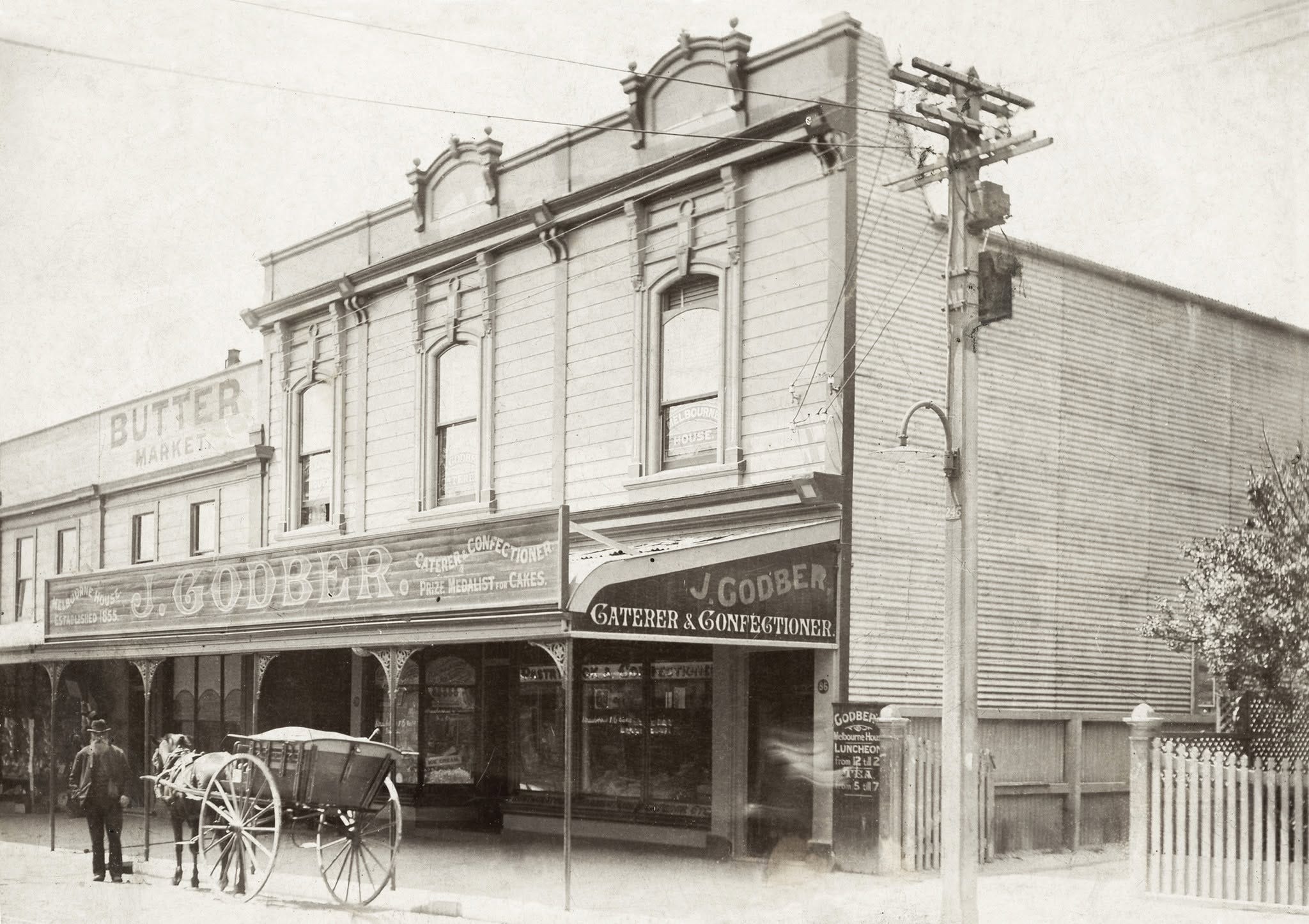
Me in the margin, perhaps: “AU: Ha!”
The only reason I’m pausing here to acknowledge this wonderful line is to say that, in actual copyediting, I would leave it unacknowledged. It’s perfect, it’s endearing, it doesn’t need my help. (But I seriously like it.)
I’m always wary of phonetic renderings of dialogue, which can come off as, here, a touch elitist and, in other cases, can also come off quite a bit worse, but this one won’t hurt anyone, so onward we press.
Yes, if you want to get all copy editor–y about it, that should probably be “that comes only from whipped cream,” and I do have a tendency to pick up “only”s I think are in the wrong place and put them where I think is the right place, but I feel right now as if God would strike me dead if I attempted it here, so: No.
Your footnotes are so good. My favorite here is the one about the olives. I could not agree more. I was glad to see the whipped cream after that!
Here's a copyediting nightmare (luckily caught before printing). I had written about modern-day Harlem being "ethnically diverse" but in the typeset ms., the neighborhood had become "ethically diverse."
A bullet, as they say, was dodged.