
Yoo-hoo!
[a book by any other name]

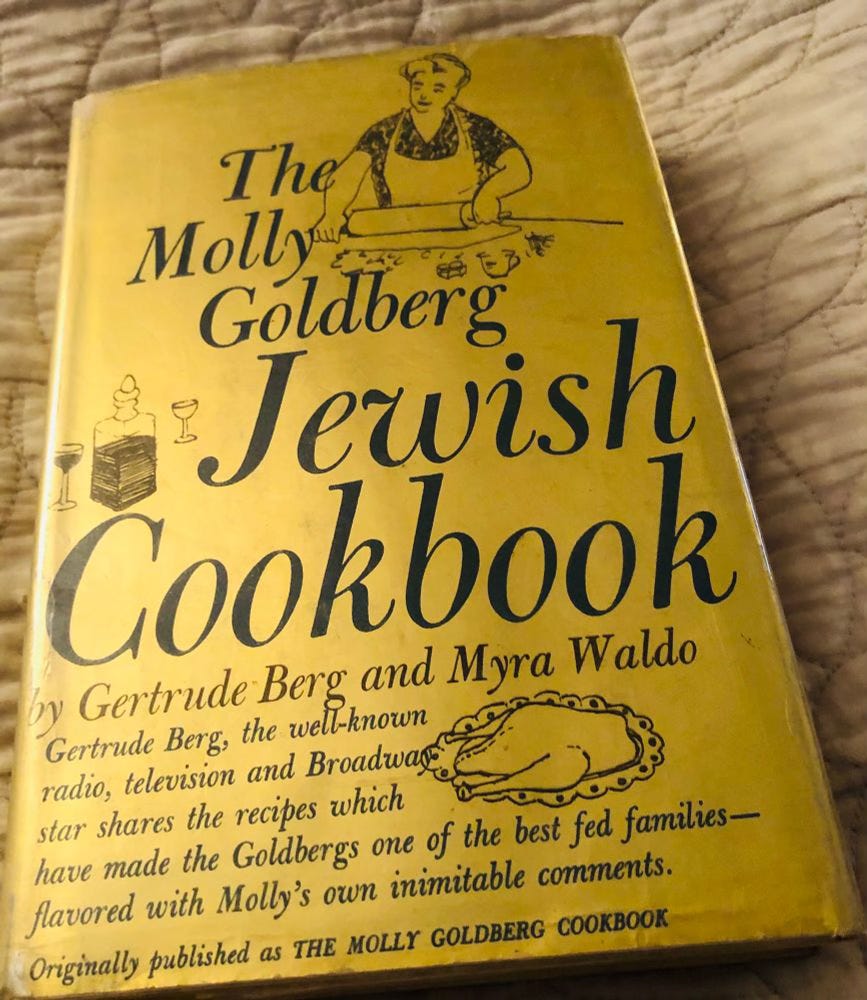
Inspired by my pal Jason Diamond’s charming essay earlier this month on Molly Goldberg’s Pickle Soup, I popped online and ordered myself a copy of The Molly Goldberg Jewish Cookbook, and my copy arrived just the other day, and I’m positively kvelling over it.1
If you’re unfamiliar with the great Gertrude Berg and her windowsill-leaning, neighbor-hailing alter ego Molly Goldberg, I commend to you the enlightening 2009 documentary Yoo-Hoo, Mrs. Goldberg, not to mention the extant episodes of the Goldbergs TV series from the very late 1940s into the mid-1950s, some of which are available on DVD, a few of which are up at YouTube; you know how to google, don’t you, Steve?2
Focusing for the moment simply on my newly arrived treasure, which I have every intention, besides reading, of cooking extensively out of (I’m just about forty-five appetizing pages in, and I’m already building an ingredients shopping list for, besides the aforementioned Pickle Soup, Cabbage and Potato Soup and, especially, Smoked Salmon Soup), we note a few things, judging a book by its cover, right off the bat:
• Some of us would have liked a series comma in “radio, television and Broadway.”
• Series comma or not, there’s an inarguable comma inarguably missing after “star.”
• I’d like to swap that “which” for a “that.”
• The phrase “best fed families” yells out for a hyphen, plus I’m at least yoo-hooing out for a follow-up phrase of “in the five boroughs,” “in America,” “in the world,” or some applicable such.
• Also, the way the y in “Broadway” goes slamming into the chicken platter: well, that’s some real IDGAF quick-on-the-draw design energy, isn’t it.
Particularly curious—at least to me—is that “Originally published as The Molly Goldberg Cookbook” line. Retitling a book post-publication is not a thing undertaken lightly. First, the retitling needs to be acknowledged on both the front jacket/cover (as you can see here) and on the title page; second, it’s simply, as you can also see here, inherently awkward-looking (especially when the retitling, also also as here, comprises a single additional word; third, retitling a book can project a distinct pong of the book’s having tripped disastrously out of the gate the first time around. (I can recall, from back in the day, a novel we published that had one title when bound galleys were printed, a second title by the time the novel arrived in the world as a hardcover, and yet a third title for the eventual paperback edition, though at that point, really, why bother.3 )
Nosing around a bit, I find that The Molly Goldberg Cookbook made its debut in 1955 not only with its Jewishless title but also credited not to Gertrude Berg but to the fictional4 Molly Goldberg (and the pleasingly prominently billed co-author Myra Waldo). (The book’s narrative/interstitial text, I should note, is written in Molly’s voice: “From Mrs. Herman I didn’t had to ask. I already knew.” The recipes are less haimish, more direct.)
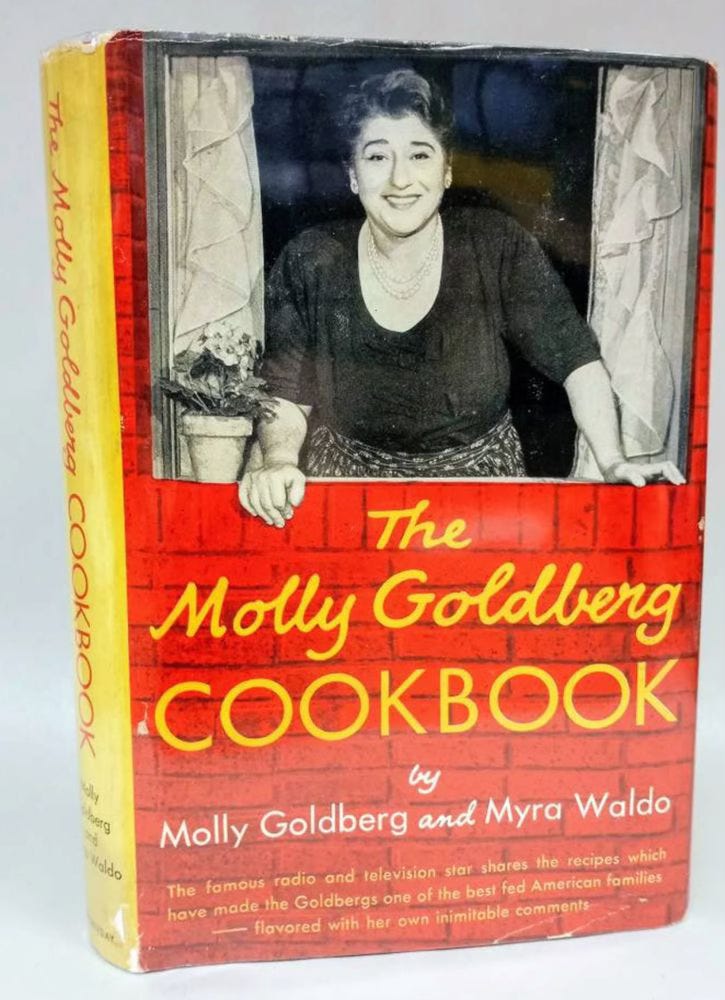
You’ll note as well that the absolutely uncredited Berg is nonetheless alluded to in the jacket line (I think this is highly awkward; I would have been, as copy chief, stamping my feet over it, for all the good it might or might not have done me) as a “famous radio and television star”; the addition of “Broadway” for the republication in 1959 gives us a bit of a clue if not to the partial retitling of the book specifically then at least to the remarketing attempt generally, because by 1959 The Goldbergs had gone off the air and Berg was on Broadway in the process of earning a Tony Award for Leonard Spigelgass’s play A Majority of One, in which she plays a Jewish widow (you were expecting maybe an Irish lady?) who falls in love with a Japanese businessman played by Sir Cedric Hardwicke, and I’ll spare you any photographs of kimono’d Sir Cedric in yellowface with his eyes taped back.5
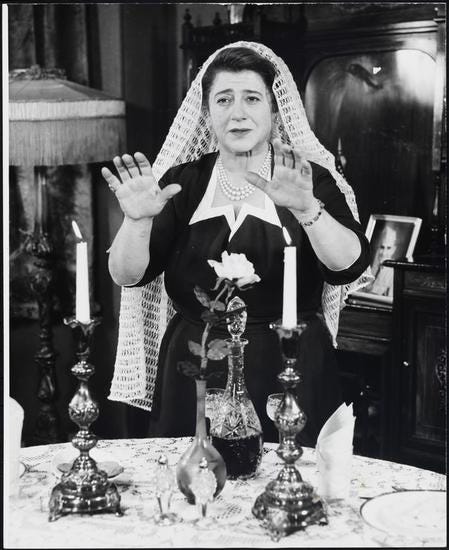
So it makes a kind of sense, then, that the book should be reoriented6 slightly away from Berg’s receding Molly Goldberg persona and set a little more squarely on Berg herself (though I still don’t quite get the need to make explicit in the title what certainly already seems quite thoroughly egg-washed and baked in). And at least, for the republication, that unmoored jacket line is now securely attached to Berg’s name twice over, another improvement.
You might be amused, by the way, to note, as a friend reminded me earlier today, that Gertrude Berg didn’t cook.
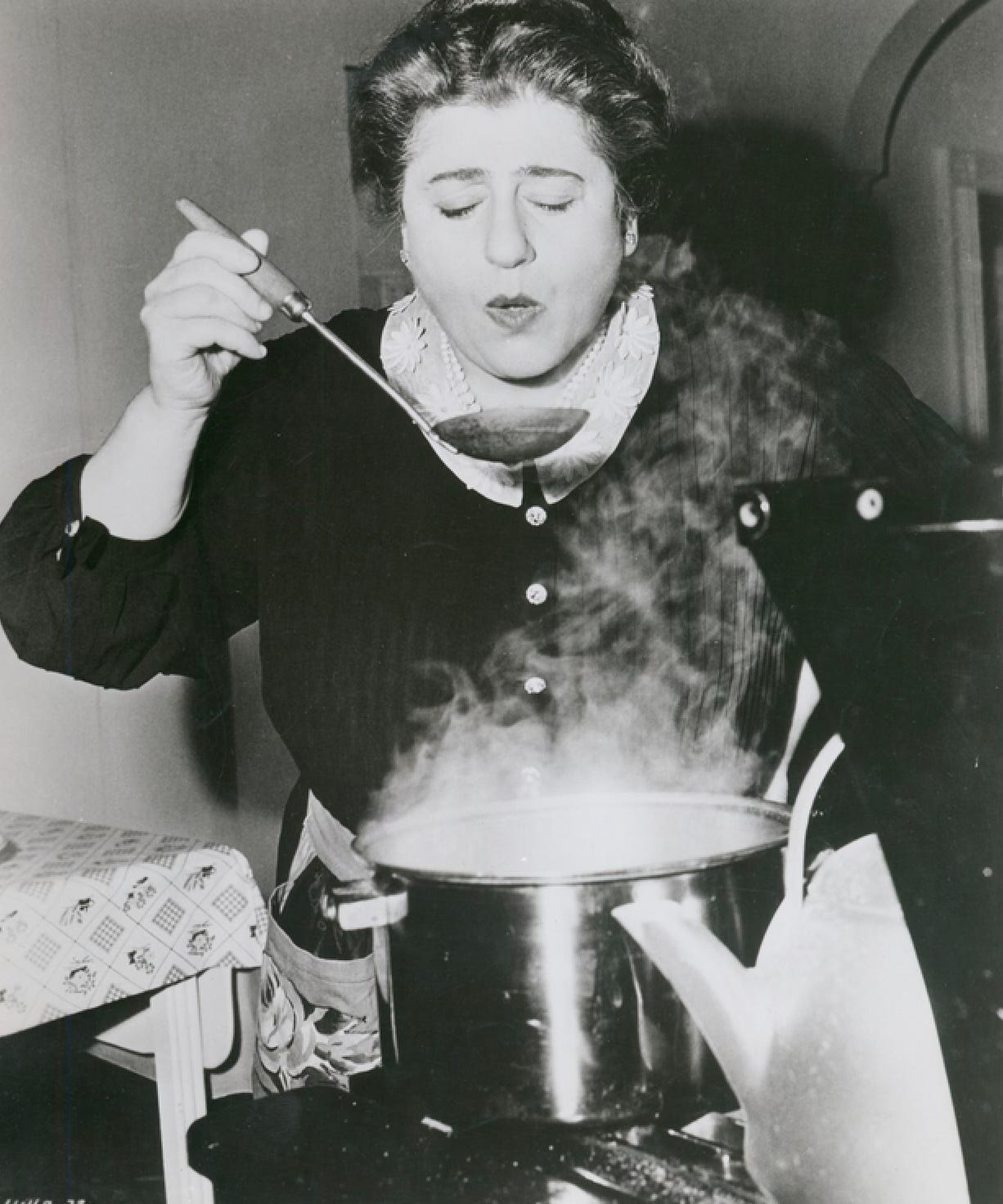
“She didn’t cook, she didn’t clean, she worked sixteen hours a day six days a week, and in her rare off hours she lived the Park Avenue high life with a staff and a supportive husband.”
Good for Gertrude!
Also, I’m now extremely hungry for, as Molly Goldberg herself would put it, a snick-snack. So toodle-oo!
As always: Thank you all for being here, and thank you, especially, to subscribers, and especially especially to paying subscribers, who make it possible for me to keep writing.
Sallie is grateful as well!

Or keeling over it, as autocorrect seems intent on.
You just curl your typing fingers, and tap.
Less direly/crucially, books occasionally pick up new titles when they migrate from the UK to the US of A, and that doesn’t need to be shouted from the rooftops, much less from their covers. Off the top of my head, I recall that we published The Stars’ Tennis Balls, Stephen Fry’s marvelous modernized riff on Alexandre Dumas’s The Count of Monte Cristo, as Revenge (can you blame us?), and my friend Ann Wroe’s superb Perkin: A Story of Deception as The Perfect Prince: The Mystery of Perkin Warbeck and His Quest for the Throne of England, the justification presumably being that American readers don’t know from Perkin Warbeck and could use a little help.
Also, the leading lady of Dumas’s Monte Cristo is named Mercédès; the leading lady of Stephen Fry’s update is named Portia.
It’ll come to you.
Copyediting note of the day: The lines separating them are a bit muddily tromped over, but “fictional” is best reserved, I’d say, for works of the literary or other artistic imagination; “fictitious” works better for things that are made up out of thin air in the thick of real life, like that one aunt of yours who died four times in three years so you could ditch school; “fictive” is simply a bit much, but use it if you need it.
One notes that Berg, in winning her Tony, an impressive enough accomplishment in its own right for an actress who’d made her career in the degraded media of radio and, shudder, television, bested Claudette Colbert in The Marriage-Go-Round (fine), Kim Stanley in A Touch of the Poet (well, OK), Maureen Stapleton in The Cold Wind and the Warm (these things happen), and Lynn Freaking Fontanne in her legendary performance as Claire Zachanassian in Friedrich Dürrenmatt’s The Visit (I mean, my God, and I bet you didn’t know that Lynn’s middle name was Freaking). One notes as well that Berg wasn’t permitted to parlay her Tony Award into a film version, because producer Jack Warner would have none of the charming, lovable, zaftig, and authentically Jewish star and instead cast in the role of Bertha Jacoby from Brooklyn (are you sitting down? I hope you’re sitting down) Rosalind Russell, but at least Roz’s Japanese lover was played more authentically in the film by Sessue Hayakawa.
[Pause.]
[For effect.]
Of course not, don’t be silly. Her Japanese lover was played by Alec Guinness, and I’ll spare you photographic evidence of that performance too.
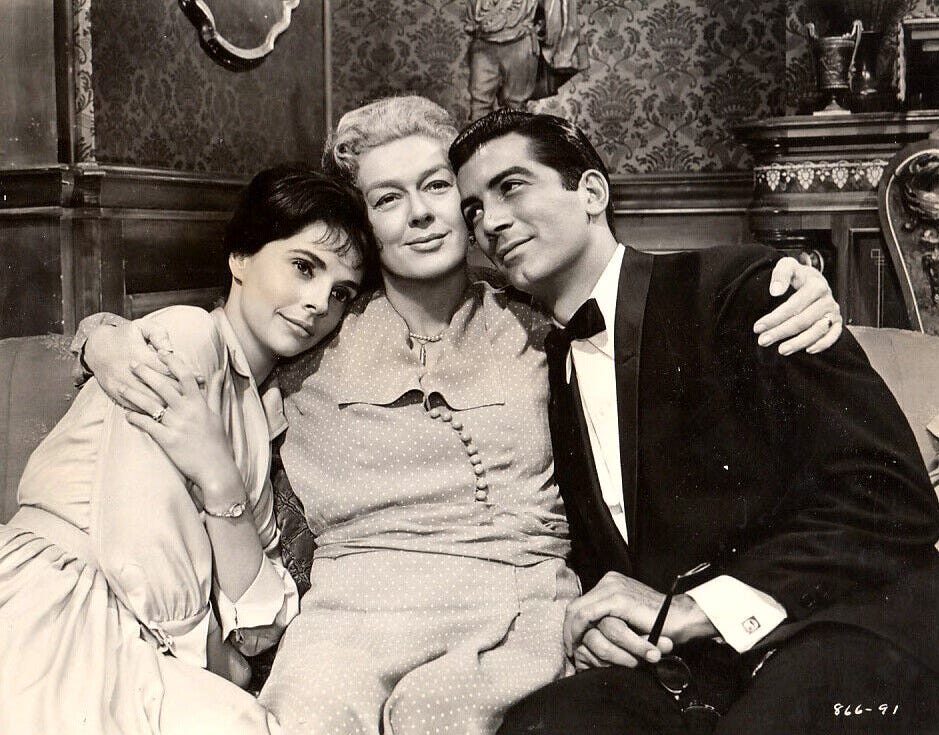
By the bye, I’ve read the playscript of A Majority of One, and I won’t say that it’s any immortal masterwork of the theater, but it’s certainly an extremely effective and affable sentimental commercial comedy, and its hands-across-the-Pacific heart is truly in the right place, which is not, in the late ’50s, nothing. As to the film, I’ve watched . . . a few minutes of it.
Sorry.
(A) I saw what you did, you know what you did, and of course I shrieked.
(B) At least in this still, it seems as if the studio decided to “age” Our Roz by approximating an early version of the Tin Man makeup used on Buddy Ebsen. She doesn’t look old; she looks like she’s been ingesting colloidal silver.
Yoo-Hoo — a delicious chocolaty drink by a most specific name.