
5 Easy Pieces
[your copyeditorial resolutions for 2026]

As a sort of pendant1 to the other day’s extended listy thing, here are, more succinctly, five of the easiest, purest, triedest-and-truest ways I can think of for you to make your 2026 writing life better and less complicated (and fresher-smelling)!
Apply the series comma. Invariably.2
Always form a singular possessive with the ’s construction.3
If you’ve yet to break yourself of the habit of setting non-English bits and pieces in italics, now’s, vastly more often than not, as good a time as any.4
Read your work aloud before declaring it over and done with. No, don’t pretend to read it aloud. Make some actual noise. You’ll be amazed at the typos and other infelicities that will announce themselves5 to you.6
The time to stop writing for the day (or at least the session) is ten minutes before the headache commences, not ten minutes afterward.
Sallie says hi.

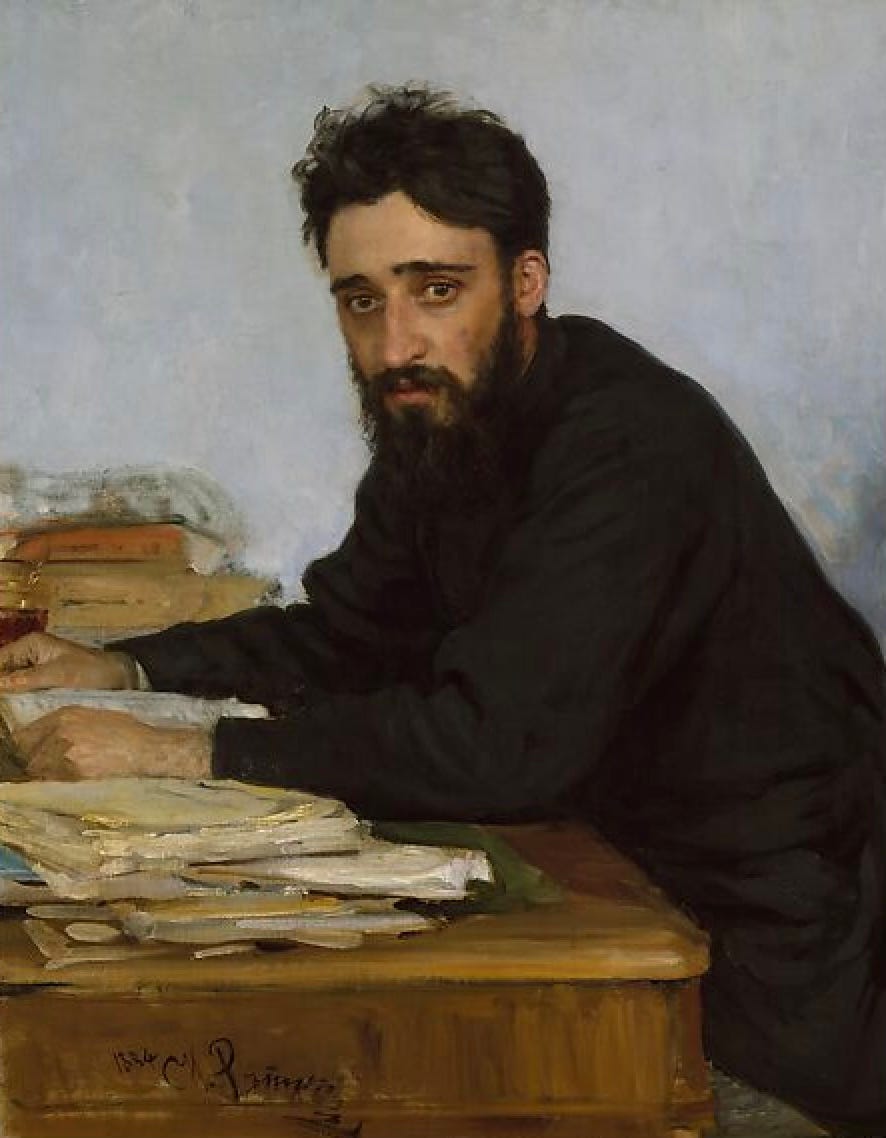
Cover painting: Ilya Repin, portrait of Vsevolod Mikhailovich Garshin7 (1884) (Metropolitan Museum of Art, N.Y.C.)
Just by the bye, there is a word “pendent.” It’s an adjective.
No sentence has ever been harmed by a series (serial, Oxford) comma; many a sentence has been saved by one. If you’re one of those people who pride themselves on applying the series comma when it’s crucial to reader comprehension and omitting it when it’s not, I can assure you, based on interminable experience, that more often than not you do precisely the opposite. Also, pausing to decide whether this or that sentence absolutely needs a series comma uses up valuable braincells you might better put to work addressing your flaws of subject-verb agreement, your habitual danglers, etc.
To be sure, we have been down this road before. One’s bag of copyeditorial tricks is not, ultimately, bottomless.
Another well-traveled road. The other day I read an otherwise perfectly charming online essay in which the writer had chosen to italicize, among other things, piazza, cappuccino, and campo. I felt as if I’d wandered headlong into Charlotte Bartlett’s beloved Baedeker.
Case in point: I’d originally written “that will make themselves known.” Didn’t take me but a second, voicing the piece, to realize that I’d just used the word “make” in the line above. I didn’t see it (though I might have, sooner or later), but I certainly heard it.
Garshin’s life was brief and ended tragically. I hadn’t heard of him before I happened on that haunting portrait; I’ve since read his stories “Four Days” and “A Red Flower”; I commend them both to you. Here’s a photograph of Garshin by William Carrick and the striking cover of his story collection.


I can't keep quiet any longer. I have subscribed.
You've included one of my favorite paintings, Repin's portrait of Vselobod Garshin. Garshin was the son of a high-ranking military officer; he went straight from school to fight in the Russo-Turkish war. He wrote a book about his war experiences, and tried to keep his hand in with journalism, but suffered so badly from PTSD that he took his own life about four years after this portrait was painted.
Repin used Garshin as a model in several of his works. You can see him in the rather gothic painting, "Ivan the Terrible and His Son Ivan on November 16, 1581", where Garshin is the son. There's a good copy of the work on Wikipedia, under Ilia Repin.
Excellent reminders. And far less fishy than 5 Easy Plaices.