
"A more perfect day."
[copyediting "The Garden Party," part 1]

[Given that today’s missive, and the follow-up missives to come, will certainly include many footnotes, I remind you that you don’t have to violently scroll down and up and down and up to enjoy them; you can simply, depending on your particular reading gadget, hover over or click on the superscript numbers and the footnotes will make themselves available to you.]
Prelude
The other day, on the 27th, known to some as Lottery Day, I found myself, in reposting a long-ago essay of mine about Shirley Jackson, freshly contemplating the anthology in which, I was reasonably certain, I had first read Miss Jackson’s infamous story.
Sure, [I’d reminisced,] like just about everybody else in America, I read “The Lottery” in junior high, no doubt in that same short-story anthology with “Leiningen Versus the Ants,” “The Most Dangerous Game,” and Katherine Mansfield’s “The Garden Party.”
It occurred to me, for the sake of my own obsessive amusement, to see if I could track down the anthology in question. Unfortunately, in googling “anthology stories lottery leiningen dangerous game” and various variations on that, all I got back for my trouble was to be looped through, M. C. Escher–ishly,1 to my own essay in which I’d mused on “that same short-story anthology with ‘Leiningen’” etc. Well, at least I’m showing up on Google; that’s reassuring.
Hauling my search woes to Bluesky, in part to pout and in part with the hope that someone might immediately know what I was trying to talk about, I suggested that the anthology also, I was reasonably sure, included “some Saki thing.”
Amazingly—or at least I was amazed—my online pal Kenny Mellman swooped in seconds later with this:
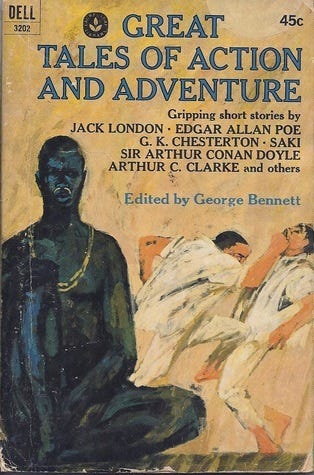
Which, guess what, is indeed the anthology I made my way through some fifty-odd years ago. I’d have known that cover anywhere.
Here’s the contents page, to prove the presence within of “Leiningen,” “The Most Dangerous Game,” and “the some Saki thing.”
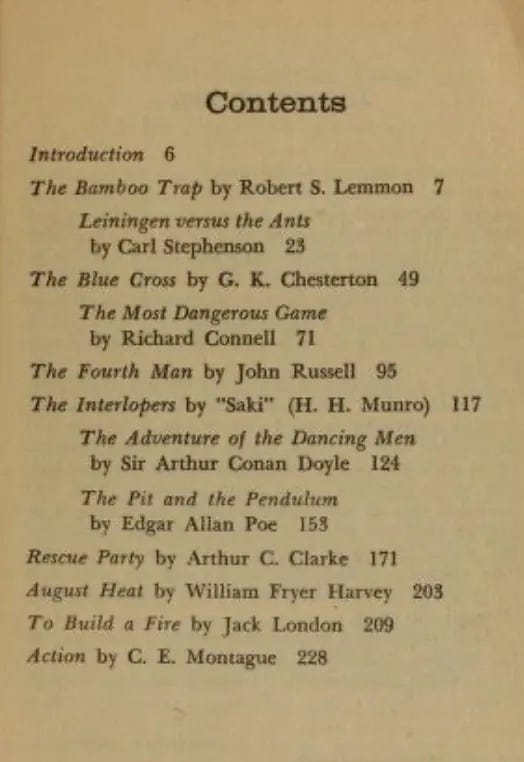
But, you’ll note: no “The Lottery,” and no “The Garden Party.”2 From which we can infer the existence of at least one other short-story anthology I was assigned in junior high school, but that’s a websearch for another day.
In any event, it occurred to me that though I’d carried around for decades an extremely favorable impression of “The Garden Party,” that was all I was carrying. I hadn’t, not that I could recall, ever read it again since seventh or eighth or whatever grade; neither could I particularly recall what it was about.3 I thought it might be fun to revisit it.
Which I did, and boy oh boy oh boy is it wonderful.
So I thought, as I mentioned the other day, that it might be fun, particularly as, as short stories go, it’s not terribly long (plus it’s in the public domain, so I’m not stepping on anyone’s copyrighted feet), to make a little party out of “The Garden Party,” and my intention, today and for assuredly a few installments to come, is to make my way through the text copyeditorially, touching on its points of interest in a way that, as usual in this A Word About . . . series, I hope you’ll find both amusing and helpful.4
Now, having cleared my throat, I clear my throat a touch more with a reminder that, as a copy editor, my mission is not—though this may shock some of you writers who have ever been copyedited, though hopefully not you writers who have ever been copyedited by me—to see how many changes I can effect over the course of a piece of text. My mission is to see precisely what changes might need to be effected, or what effective queries I might want to pose, in hopes of, as I’ve been known to say, trying to help make a piece of writing into the best possible version of itself that it can be.
As “The Garden Party” is, indeed, boy oh boy oh boy wonderful, quite possibly I won’t have much to do/effect/query as I progress (I haven’t plotted this course at all beyond preparing to pull away from the dock), but we’ll see what happens.
Methodologically, let’s go with my favored style for this sort of exercise, the endless string of footnotes.
OK, let’s roll.
And5 after all6 the weather was ideal. They could not have had a more perfect day for a garden-party7 if they had ordered it. Windless, warm, the sky without a cloud.8 Only the blue was veiled with a haze of light gold, as it is sometimes in early summer.9 The gardener had been up since dawn, mowing the lawns and sweeping them,10 until the grass and the dark flat rosettes where the daisy plants had been seemed to shine. As for the roses, you could not help feeling they understood that roses are the only flowers that impress people at garden-parties11;12 the only flowers that everybody is certain of knowing. Hundreds, yes, literally hundreds,13 had come out in a single night;14 the green bushes bowed down as though they had been visited by archangels.15
Breakfast16 was not yet over before17 the men came to put up the marquee.
“Where do you want the marquee put, mother?”18
“My dear child, it’s no use asking me. I’m determined to leave everything to you children this year. Forget I am your mother. Treat me as an honoured19 guest.”
One gets warned around here when one is about to hit a content limit that will make emailing difficult, and I’ve just been so warned, so I’m going to stop here for today.
I’ll be back relatively asap to continue this escapade, and hopefully (we’ll see) to pick up the pace a little, or early summer will quickly be late summer.
Today’s Wednesday, right? So let’s say Friday or Saturday. Sunday latest.
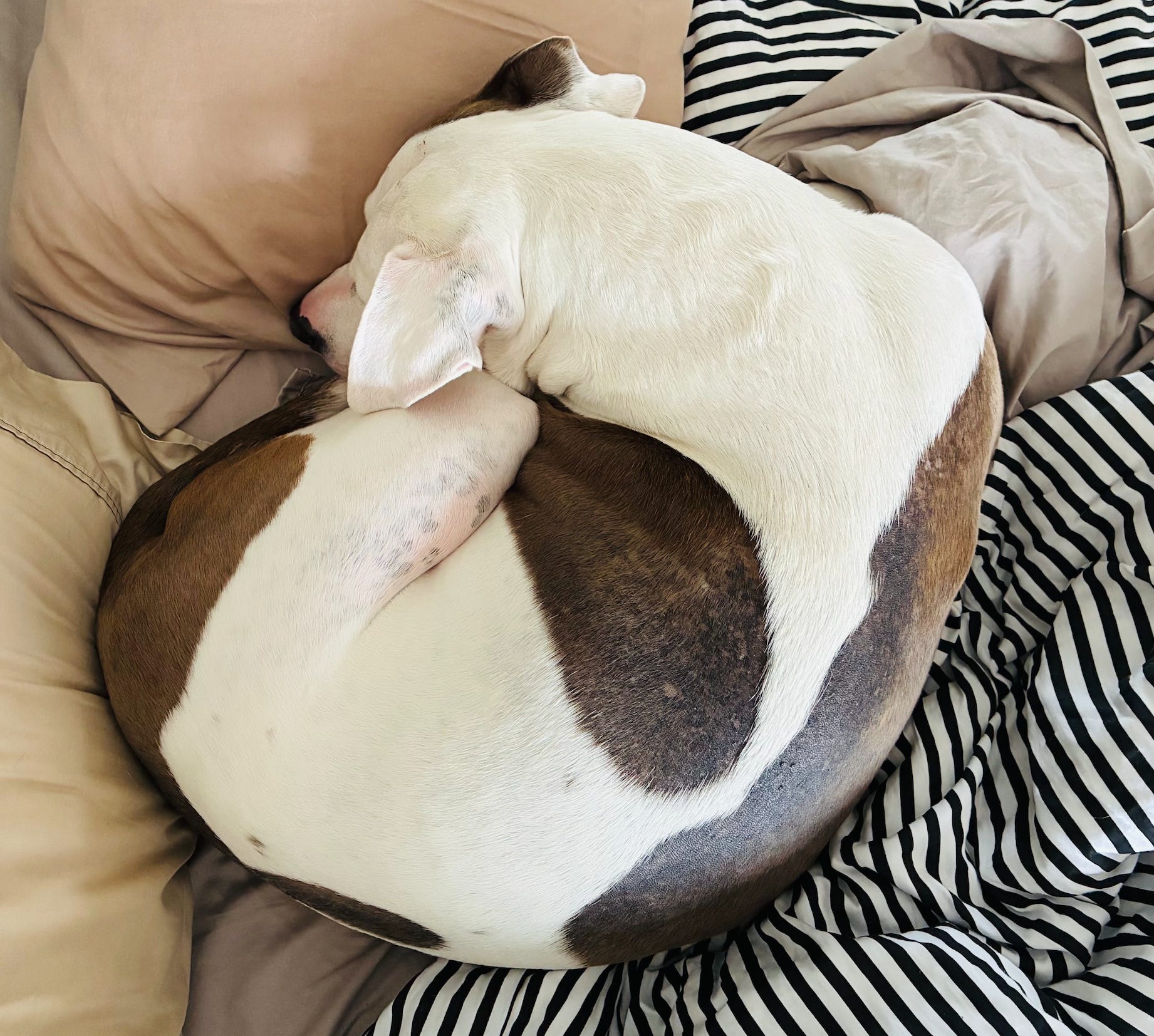
Thank you, as always, for being here, and I extend my usual additional thanks to subscribers, with particular gratitude to paying subscribers, who help keep me in business (and who in return for their generosity are enabled to comment in the comments), and I provide you with a photograph of a perfect dog, as some of you get miffed when these installments are Sallie-less.
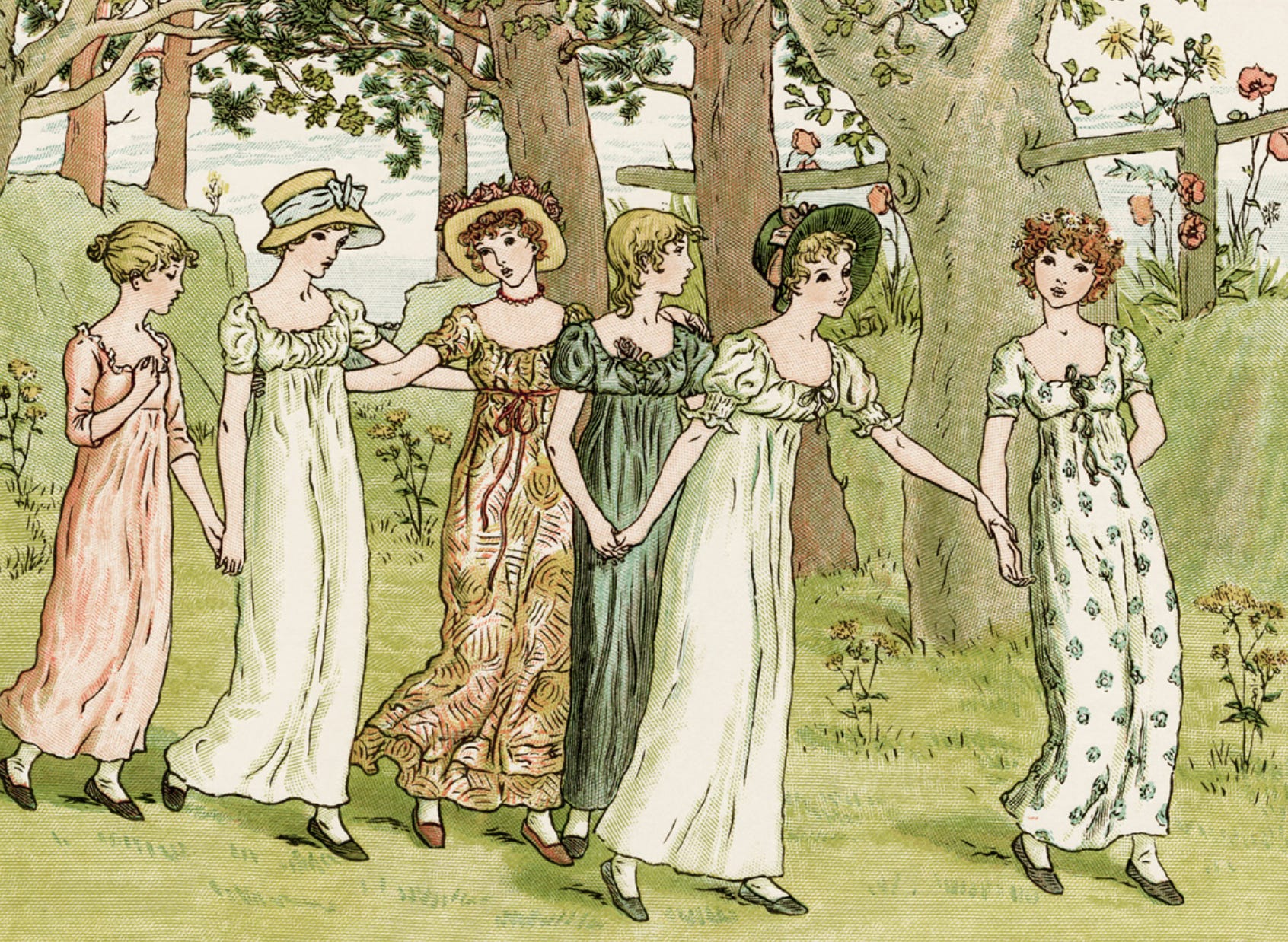
Cover illustration: Kate Greenaway, “From Market” (1885) (chromolithograph)
En dash alert!
All the tales of action and adventure were written by men; I bet you already noticed that.
“It’s about this . . . garden party.”
I have other, ulterior purposes re this adventure, but for the moment I can and will keep them to myself.
OK, you knew that was going to happen. First word in, first footnote. I am delighted that the first word of this story is “And,” because that’s another sprightly stake in the heart of the hoary, moldy notion that proper sentences don’t begin with “And” (or “But”). Proper sentences often do begin with either, though as I do also like to remind, one should have a good reason, or at least a reason, some reason, to begin them thus. Does Mansfield have a good reason? (Not that she has to to satisfy me; it’s her story.) I’m going to go with yes. Because what she’s done is to draw you right in, chattily and chummily, to the story, almost as if you’re sitting opposite her in a drawing room (or drawing-room, as she might possibly have punctuated it) and she’s just leaned (or leant) over and, with a gentle smile, taken your hand. The tale is already under way, and now you get to catch up. I love this sort of thing.
Should there be a comma here?, some of you are, I bet, thinking. A, One is not crying out to me to be set. B, A comma would interrupt, immediately, that great graceful leap into the midst. C, Don’t mess with a writer’s first line if you can help it. It’s no way to make a friend.
In the Mansfield collection from which I’ve taken this story, the title is given as “The Garden-Party.” But here’s the case of the book:
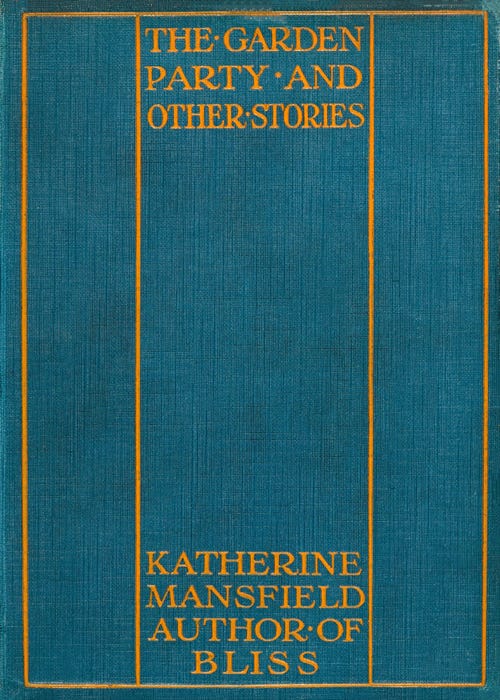
And here’s a dust-jacketed edition that will set you back about five large.
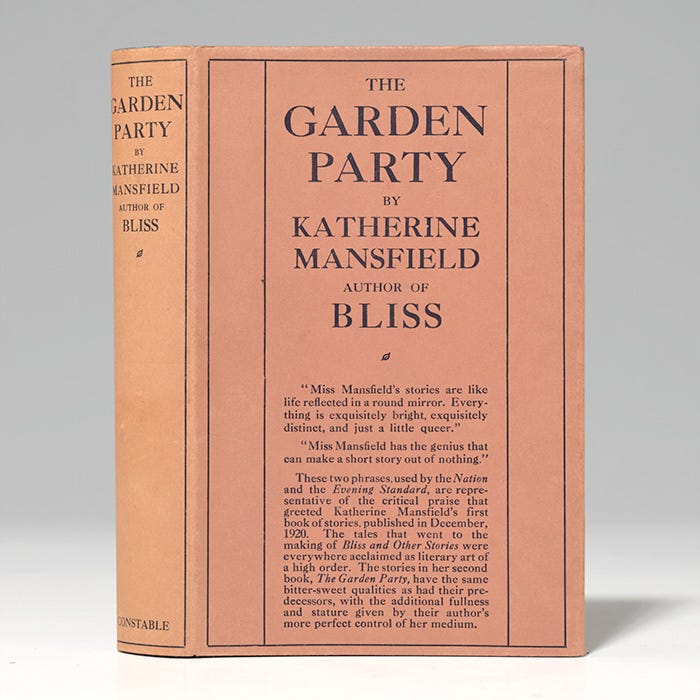
Mostly I would like us to make up our minds. But I can feel myself, back in my Random House copy chief/man. ed. office days, beseeching for the addition of a hyphen to the title of the book proper, to match the story, only to be met with myriad sets of rolling eyes. Yes, fine, no one wants to see a dainty hyphen in a book title, I get it, but then let’s perhaps take the hyphen out of the story title and its text?
What’s done is done, and the copy editor’s job, going forward, is simply to make sure that the phrase “garden-party” remains “garden-party” and doesn’t flip over to “garden party” when no one’s paying attention.
And we have our first sentence fragment. Hooray! I’m as happy about this as I am about the story-opening “And.” Yes, I understand why your/our junior high school English teachers tried to stop you/us from doing this sort of thing, but we are no longer in junior high school. We have learned the rules, and by gum we’re going to start breaking them. For a good reason. What’s the good reason here? I don’t know. It reads nicely? It’s fun? Could this also have been “if they had ordered it: windless, warm, the sky without a cloud”? Yes. But it’s not. So let’s move on.
The wise copy editor has just made a note for their eventual style sheet that the story takes place in early summer. This might be important if there’s an allusion to what flowers are blooming, or what time the sun goes down. Or it might not be important at all, but it’s a thing we want/need to know and keep track of.
Could this have been “mowing and sweeping the lawns”? Yes. And my maternal grandmother could have been a Schwinn bike, but she wasn’t. Again, you copyeditorial types: Your mission is not “How might I rewrite this so it’s more the way I might have written it myself?” Or, worse, “How might I axe away at this so that I’ve deleted as many words as possible?” We have all the time and space in the world. Let’s let our writer cook.
Hyphen. Yes.
That semicolon. I love semicolons. This is no place for a semicolon. A comma will do just fine. Semicolons are not, as some writers attempt to wield them, emphatic commas. They’re semicolons, and they do semicolon duty. Will I suggest in the margin “AU: Perhaps just a comma here?” Yes. I might not even suggest it; I might simply change it, with or without an accompanying “AU: OK?” And we’ll see how AU responds.
I don’t always love a “literally,” a literal “literally” or, certainly, a figurative “literally.” I’m charmed by this “literally.”
Much better.
Oh, that’s just lovely. Are copy editors allowed to, in the margins, occasionally leave a note like “AU: Oh, that’s just lovely”? Yes. Sparingly. Really, really, really sparingly.
And now we know, too, that it’s morning.
Do you want this “before” to be a “when”? I think I might. I’m, truly, not sure, so not being sure I’m probably not going to query it.
I note two things here: 1, we don’t know who’s speaking, except that it’s the child of the person called “mother,” whom I would prefer to call “Mother.” (That’s thing 2.) And, again, I like the way this is going. The absence of a “[Someone] said” makes us, I think, feel as if we’re part of the story, an intimate of the characters, and we’re simply overhearing the conversation. Or are even a part of it. That is, we don’t need to be told who’s speaking. We know who’s speaking. If you follow me.
OK, we’re using Brit. spelling here, and let’s simply save that entire conversation for another day, or we’ll be here for the entirety of this one.
I was well into adulthood when I learned, after considerable confusion, that a British "marquee" is not an American "marquee."
Master class!