
A Word About . . . a word
[a rainy-day story]

It’s absolutely pouring out here in Sunny So. Cal. today, and apparently will be for the rest of the week, so as my usual long leisurely morning stroll along the Venice boardwalk is utterly out of the question, I thought I’d tell you a story instead.
In 1973, in the summer of my sixteenth year,1 I took one of those young persons’ trips to Israel. It might have been for six weeks, it might have been eight. I’m not really sure, and I’m not inclined to spend too much time today trying to fact-check my own existence. It’s more than enough, most days, simply to have existed through it.
It was my first time ever out of the United States, and it was, as hoped for, a full and vivid experience. We visited Jerusalem (sojourning at the YMCA, oh the irony, across the way from the King David Hotel, but I note that it was also the poshest place we stayed the entire journey) and Haifa (in my recollection, an entire city built out of gleaming white stone), we spent a week or two on a kibbutz, rising at what we were told was three in the morning (I call it the middle of the g.d. night) to breakfast on salad, which is insupportable, and pick pears as the sun was rising and until it became too hot to do anything else or anything at all, which inculcated into me a lifelong aversion to pears (and heat). The Sinai Peninsula was still, then, Israel-occupied territory, and during a lengthy bus trip we climbed what may or may not be the Absolutely Authentic Mt. Sinai and visited Saint Catherine’s Monastery, within whose confines Moses’s2 Absolutely Authentic Burning Bush can be found, and I recall our being told that, during one round of renovations decades before, the bush, in the dead of night, miraculously and considerately scooted a few yards out of the way of the expansion of the monastery’s refectory.3
We also spent some time in Tel Aviv, which looked to me then very much like Miami Beach, and for all I know it still does look like Miami Beach, but I’ve never been back, so I can’t say for certain.
While we were in Tel Aviv a bunch of us went one night to see Kazablan, which was, for the Israelis, a huge deal, a big-budget movie musical based on a 1966 stage musical based in turn on a 1954 nonmusical play, so truly a long-running cultural totem. At least in its movie musical version it’s a kind of semi-comical spin on West Side Story, in which a Moroccan roughneck named Kazablan (Kaza, for short), backed by his very own prancing, twirling gang of good-natured ne’er-do-wells (imagine the Jets as choreographed by SCTV’s Juul Haalmeyer), falls in love with a nice Polish girl named Rachel and is forced to navigate accusations of thievery and his first encounter with gefilte fish. Everything eventually works out fine for everyone, and the film’s celebratory finale is probably the only musical circumcision pageant, complete with joyous ululating, in cinema history. Arthur Freed, why didn’t you think of that?
It was a grand thing to witness, and the packed theater was raucously merry; I recall that one of the audience’s demonstrations of approval was to roll empty beer bottles down the aisles. Also, I suppose, there must surely have been English subtitles, because I certainly remember being able to follow the whole story, and my Hebrew then was just about nil. (Now it’s even niller.)
The next day or so, I popped into a record store and bought the soundtrack album, which in due course of time I carefully packed into my trunk, probably nestling it in the folds of the sheepskin coat I wore a few times once back home on Long Island and never wore again, for among other reasons because it never quite gave up its pong of origin.
Back home on Long Island, I also thought to share the soundtrack album with our synagogue’s cantor’s wife, who presided over the children’s choir of which I was then still a member.
Now, our synagogue’s cantor’s wife was named Helen Belink—her husband was Cantor Norman Belink; I recall sitting with Cantor Belink in his office as he recorded my bar mitzvah Torah and Haftorah portions, chanting them into a microphone as the record, uniquely created for each of us soon-to-be thirteen-year-olds, threw off fine curls of black vinyl as the needle inscribed his voice—and it would be fair to say that Helen, as one was always permitted to call her, was one of the most important grown-ups in my life back then: vivacious, engaging, endearing, and, especially, interested, also possessed of a marvelously showbizzy perspective on our semi-nonsecular4 musical programs.
I lent the Kazablan album to Helen, who a few days later returned it to me, noting that she wasn’t particularly impressed with it except for a single track—one of those marketplace numbers belovèd of the genre; think Brigadoon’s “Down on MacConnachy Square,” except in Hebrew—in which vendors hawk their wares in counterpoint and squabble ostensibly hilariously, including, in this case, an appropriation, barely reworked, of the “It was a horse” / “It was a mule” bit from Fiddler on the Roof.
Lyrically, Helen noted, the song was passably interesting.
If only, she added, it hadn’t been set to “that insipid waltz.”
In all of my many decades since, I have never—never—forgotten Helen’s “that insipid waltz.” Not only because I’d probably never heard the word “insipid” before—it’s a spectacular word; I use it all the time now—but because, and far more important, someone I looked up to, admired, idolized, was happy to speak to me person to person, even adult to adult, without a speck of either indulgence or condescension.
For the record: It’s an extraordinarily insipid waltz, which I know well because I still listen to it from time to time, along with the rest of the score—at some point or other I acquired it digitally—and I chuckle over it every single time and think of Helen, who’s been gone who knows how many years now but remains right here with me.
Please use the word “insipid” at some point today and make Helen’s shade smile.
If you really, really, really want to, you can check out the number— “We Are All Jews,” it’s called, G-d help us, and I’m warning you, the Carousel Waltz it ain’t—at YouTube, in a fuzzy clip, with improbably Spanish subtitles, from Kazablan’s simultaneously filmed English version.
I hope that, wherever you are, you are safe and warm and dry.
I extend my thanks to all of you readers, particularly those of you who subscribe to this series, with, yes, particular thanks to those of you who’ve gone out of your way to support my work here financially, helping to keep the lights on with no greater reward (besides my gratitude) than to be able to kibitz—etymologically unrelated to kibbutz—in the comments.
In all other regards, this content is, as it has been, free to all.
Sallie, who abhors the rain even more than I do, sends her best regards.

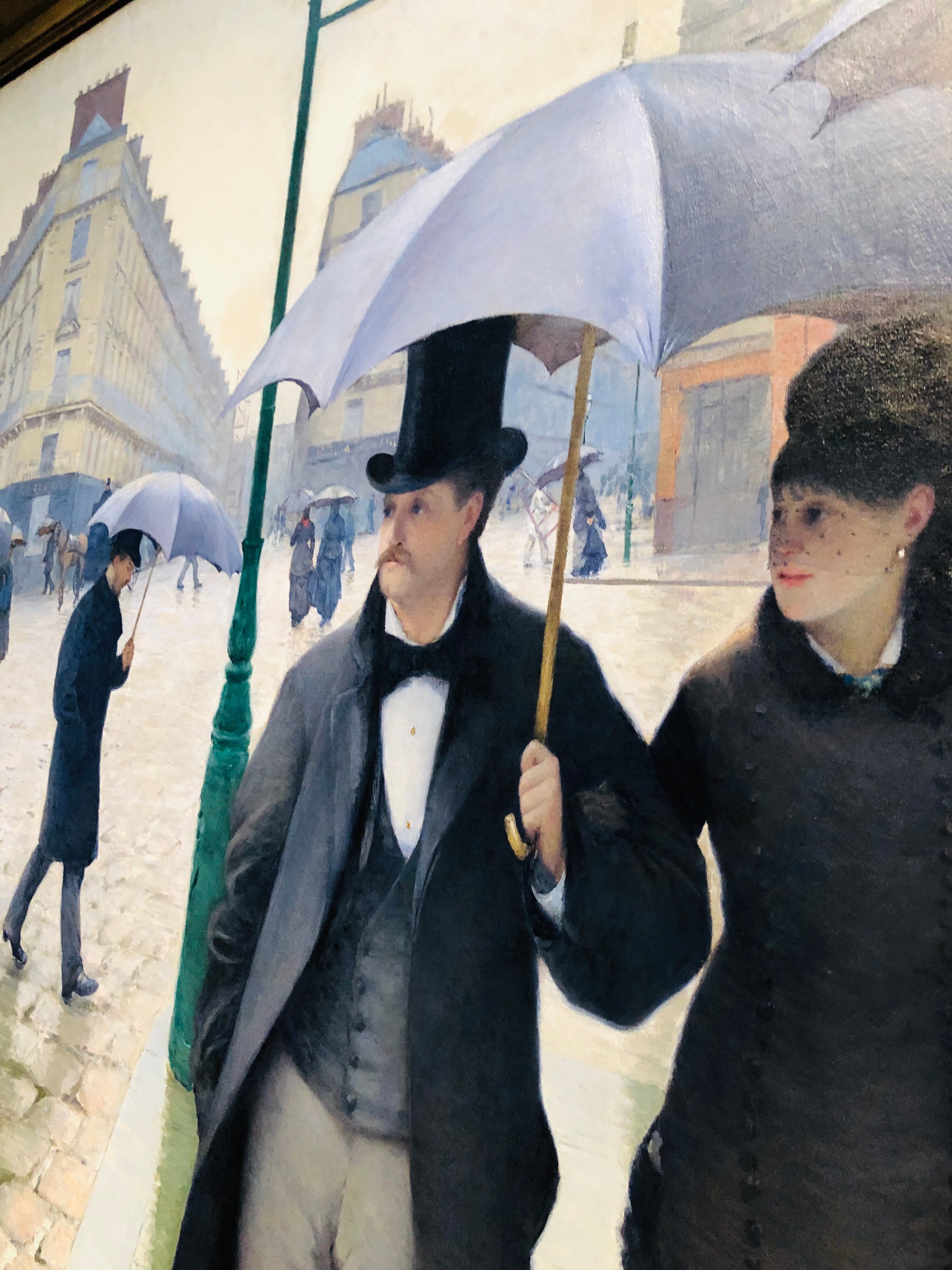
Cover painting: Gustave Caillebotte, Rue de Paris, temps de pluie (1877) (detail)
Which is to say that I was fifteen years old. Not everything needs to be a copyediting lesson, and today’s missive will not be particularly copyeditorial, maybe just a little, but people get this wrong over and over, so it’s worth pointing out, I think, over and over.
For more on my preference for “Moses’s” over “Moses’,” please feel free to revisit my previous essay on the subject of all sorts of possessive constructions. .
[Content warning: pain and suffering.]
Oh, right, yes. It was also in the Sinai that, one afternoon, I suddenly felt a stabbing pain in my left foot and, thinking to investigate the cause, moved to remove my regulation pilgrimage-mandated hiking boot, which, mystifyingly, wouldn’t be removed because, it was soon realized, it had been pierced by a six-inch thorn I’d somehow managed to step on, and so had my foot been. Once the thorn had been extracted and it had been ascertained that (of course) I’d had all my pilgrimage-mandated shots and wasn’t about to die of tetanus or some such, I simply went on my limping way. These days I’d milk such a mishap for all it was worth.
Also: Not to overpaint the lily, but later that summer, at the kibbutz, the heavy metal basin of a large outdoor sink dislodged itself from its post and landed spang on my (happily, other) foot, and you can still see, faintly, the scar.
It was a dangerous summer for my lower appendages.
To this day I never wield either “secular” or “nonsecular” without looking them up, because I almost always think that the one is the other and the other is the one. If you follow me.
Cold outside! Must go insipid some hot chocolate.
How insipid can ululating be?