
jumping the mouse, part 2
[in conclusion]

When last we met, as you may or may not recall, I was meditating on a mouse, specifically this Mickey Mouse–looking1 creature from the 1934 Laurel and Hardy film March of the Wooden Soldiers:
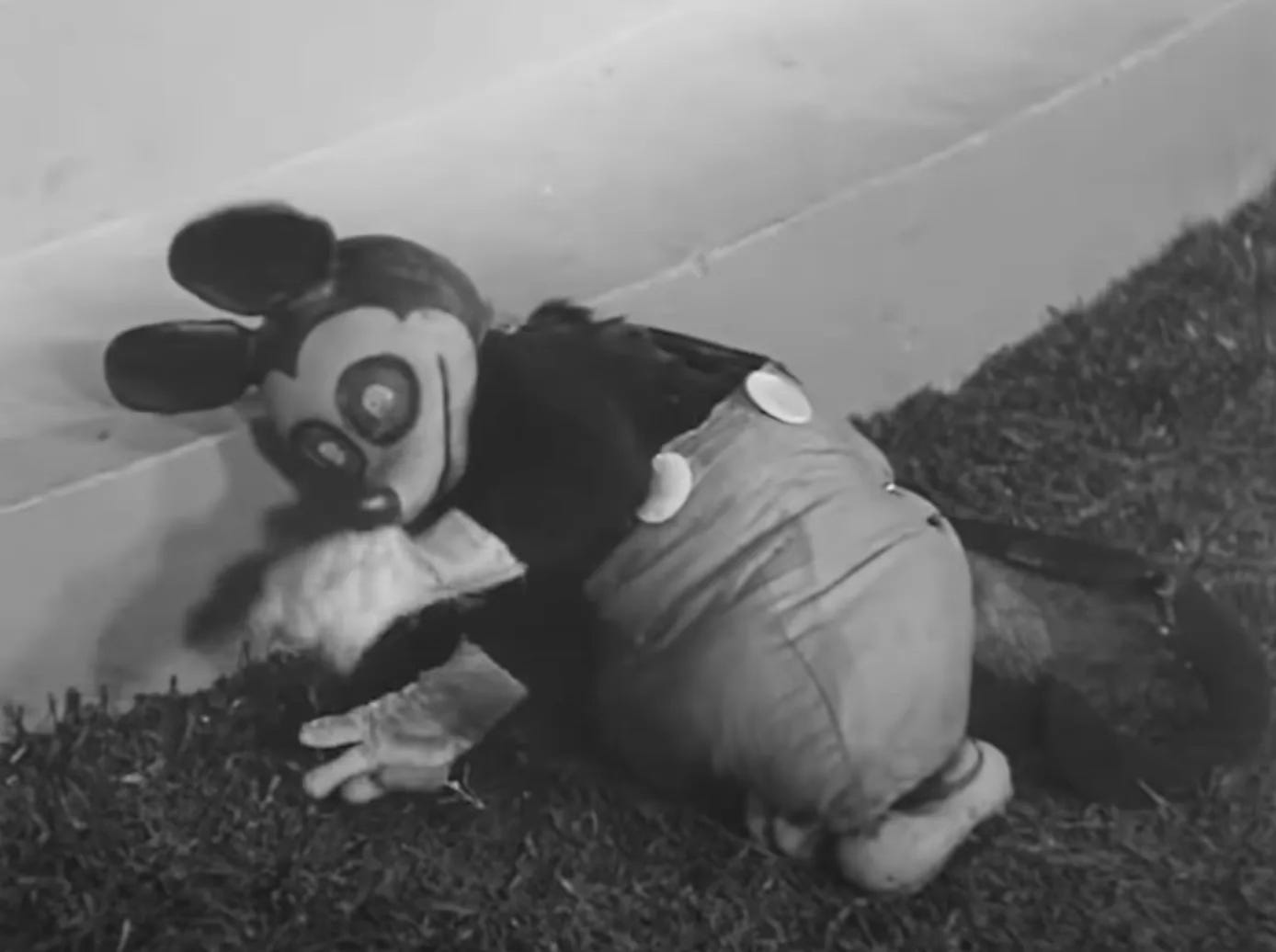
My point, in brief, was that I had gone through innumerable viewings, through numerable decades, taking for granted that a thing I viewed as a mouse, simply because it looked like a mouse (well, a nightmarish anthropomorphic Culver City fairy-tale version of a mouse) and acted like a mouse and because, having assigned it mouseitude, I never so much as paused for even a moment to think about it again, was in fact a mouse.
When, in fact, it’s a monkey.
In a mouse costume.
A monkey in a mouse costume.
Ye gods.
My mouse meditation was, in that semi-free-associative way I have, inspired by a recent sighting of the phrase “jump the shark,” which is defined, as quite possibly I don’t need to tell you, as “to reach a point where something stops becoming more popular or starts to decrease in quality.”
When I first encountered the phrase—I’m guessing in the early years of our current century—I more or less lickety-split inferred its meaning and commenced, on occasion, to use it, without, somehow, ever pausing for even a moment to consider whence it derived.
In short, I moused it.
As I’ve since learned, and as, if you don’t already know the whole saga, you can read for yourselves elsewhere in exhaustive and possibly even exhausting detail, “jump the shark,” coined in the mid-1980s, derives from a 1977 episode of the fifth season of the sitcom Happy Days in which Henry Winkler, as Arthur Herbert “the Fonz” Fonzarelli, water-skis over a live shark, at which point, we are told, a TV series that had previously been known for its hard-hitting, neorealist portrayal of American bourgeois life in the 1950s and 1960s suddenly got too silly for its own good and embarked on an inevitable and, in this case, protracted decline. (Happy Days eventually eked out eleven seasons.)
Which is to say, retroactively retrofitting the idiom in question, it jumped the shark.
All of which is to say that, at least for me, there’s something wondrous about the phrase “jump the shark,” which somehow manages to sound like (again, at least for me) precisely what it metaphorically means, even if you, or in this case I, have, or had, no idea what it literally means.
What a glorious thing English is.
With that, I take my leave of you for the year 2024, and I’ll meet you back here in, as much as I’d be happy to sleep through it, 2025.2
As Joni Mitchell says at the conclusion of her superb 1974 live album Miles of Aisles: Thank you for your presence and being here and everything.
Happy new year!
Benjamin
P.S. Maybe we can make “to mouse” a thing.
P.P.S. Nah.
Sallie has already made her decision.

Belatedly: En Dasher, en Prancer …
Hate to rain on your parade, deer.
I saw Fonzie jump the shark in real time. It was awful.
Happily, Henry Winkler is again (following a long post-shark hiatus) the epitome of cool.