
"more lilies still"
[Copyediting "The Garden Party," part 4]

[Today’s missive includes many, many, many footnotes, so I remind you that you don’t have to violently scroll down and up and down and up to enjoy them; you can simply, depending on your particular reading gadget, hover over or click on the superscript numbers and the footnotes will make themselves available to you.]
Hello again.
To publicly answer a privately asked question: In fact, I haven’t already gone through the entire Katherine Mansfield story “The Garden Party”—beyond, that is, having read it in full last week or so—and added all my copyediting and commentary so as to be able to dole it out here in copyediting-plus-commentary parcels. I’m really doing this in real time, a couple of hours at a pop, parcel by parcel, sentence by sentence, comma by comma, etc. by etc.—though I would not, in actual copyediting work, on the clock, be pausing quite so frequently to rhapsodize about what our writer has done and, of course, to chat with you.1
I also, at this point, have no idea how long this is going to go on, or how many installments this is going to comprise,2 but I assure you (or threaten you) that I’m not going to get bored and give up on the project.
So on your mark (part 1), get (part 2) set (part 3), go.
The front door bell3 pealed, and there sounded the rustle of Sadie’s4 print skirt5 on the stairs. A man’s voice murmured; Sadie answered, careless,6 “I’m sure I don’t know. Wait. I’ll ask Mrs Sheridan.”7
“What is it, Sadie?” Laura came into the hall.
“It’s the florist, Miss Laura.”8
It was, indeed.9 There, just inside the door, stood a wide, shallow tray full of pots of pink lilies. No other kind. Nothing but lilies—canna lilies,10 big pink flowers, wide open, radiant, almost frighteningly alive on bright crimson stems.
“O-oh, Sadie!” said Laura, and the sound was like a little moan. She crouched down as if to warm herself at that blaze of lilies; she felt they were in her fingers,11 on her lips, growing in her breast.
“It’s some mistake,” she said faintly. “Nobody ever ordered so many. Sadie, go and find mother.”
But at that moment Mrs. Sheridan joined them.
“It’s quite right,” she said calmly. “Yes, I ordered them. Aren’t they lovely?” She pressed Laura’s arm. “I was passing the shop yesterday, and I saw them in the window. And I suddenly thought for once in my life I shall have enough canna lilies. The garden-party will be a good excuse.”12
“But I thought you said you didn’t mean to interfere,” said Laura. Sadie had gone.13 The florist’s man was still outside at his van. She14 put her arm round her mother’s neck and gently, very gently, she bit her mother’s ear.15
“My darling child, you wouldn’t like a logical mother, would you? Don’t do that.16 Here’s the man.”
He carried more lilies still, another whole tray.
“Bank them up, just inside the door, on both sides of the porch,17 please,” said Mrs. Sheridan. “Don’t you agree, Laura?”
“Oh, I do, mother.”
In the drawing-room18 Meg, Jose19 and good little Hans20 had at last succeeded in moving the piano.
“Now, if we put this chesterfield against the wall and move everything out of the room except the chairs, don’t you think?”21
“Quite.”
“Hans, move these tables into the smoking-room, and bring a sweeper to take these marks off the carpet and—one moment, Hans—” Jose loved giving orders to the servants, and they loved obeying her.22 She always made them feel they were taking part in some drama.23 “Tell mother and Miss Laura to come here at once.”
“Very good, Miss Jose.”
She24 turned to Meg. “I want to hear what the piano sounds like, just in case I’m asked to sing this afternoon. Let’s try over ‘This life is Weary.’”25
Pom! Ta-ta-ta Tee-ta! The piano burst out so passionately that Jose’s face changed. She clasped her hands. She looked mournfully and enigmatically26 at her mother and Laura as they came in.
This Life is Wee-ary,27
A Tear—a Sigh.
A Love that Chan-ges,
This Life is Wee-ary,
A Tear—a Sigh.
A Love that Chan-ges,
And then . . . Good-bye!
But at the word “Good-bye,” and although the piano sounded more desperate than ever, her face28 broke into a brilliant, dreadfully unsympathetic smile.29
“Aren’t I30 in good voice, mummy?” she beamed.
This Life is Wee-ary,
Hope comes to Die.
A Dream—a Wa-kening.
But now Sadie interrupted them. “What is it, Sadie?”31
“If you please, m’m,32 cook says have you got the flags for the sandwiches?”
“The flags for the sandwiches,33 Sadie?” echoed Mrs. Sheridan dreamily. And the children knew by her face that she hadn’t got them. “Let me see.” And she said to Sadie firmly, “Tell cook I’ll let her have them in ten minutes.”
Sadie went.
Let’s, once again, take a breather, and I’ll be back tomorrow or, likely, Thursday, and we’ll press on.
Thank you for being here, thank you for subscribing (if you’re subscribing34), and Sallie sends her best.
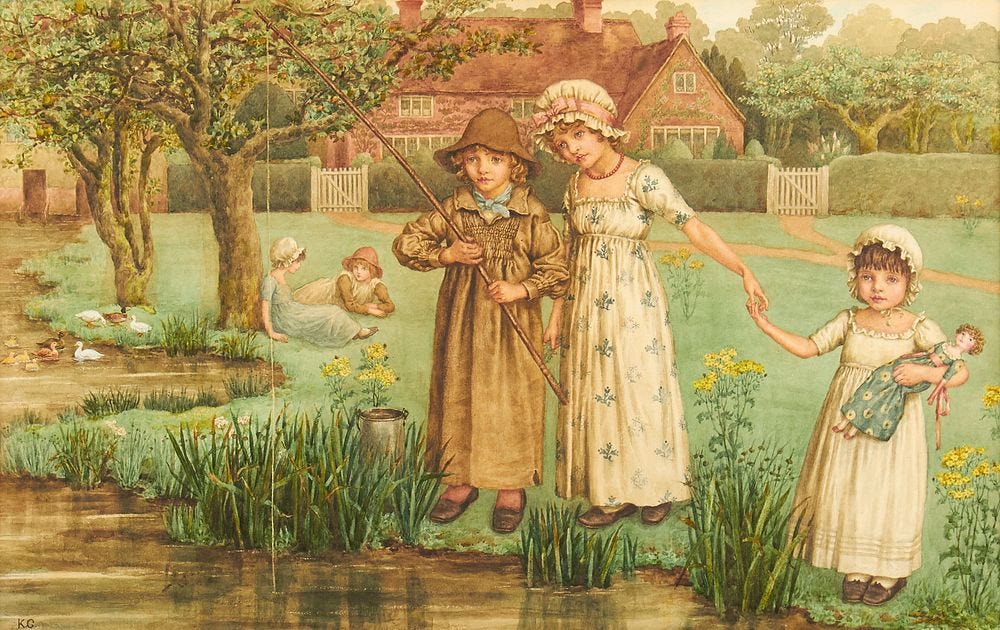
Cover illustration: Kate Greenaway, “Children Fishing,” c. 1880
Also, if I were truly copyediting this story, for pay, I’d be going through it, in its entirety, twice. You’re getting the first read, so some of my comments below might not survive, or might be altered, on a second go-through.
Am I really only about a third of the way through the story? Apparently.
The construction “doorbell” (rather than “door bell,” that is) seems to have been in use in Mansfield’s day, if relatively in its infancy, but as this is not the “front doorbell” (as opposed to the “rear doorbell”) but the doorbell of the front door (am I making sense?), I’m happy with this setup: “front door bell.” See also “used book store.”
A new character has arrived. We add her name to the style sheet. Another sister? I have my doubts.
Post-publication addendum #1: One astute reader wonders about the rustling of Sadie’s print skirt, and so now I’m wondering about the rustling of Sadie’s print skirt too. As always, query succinctly and nonthreateningly: “AU: Is it Sadie’s print skirt that’s rustling, or her undergarments?”
“Careless” rather than “carelessly” is a choice. I like it. It characterizes Sadie entirely, not just this one bit of dialogue. (I don’t mean to be pulverizing every bit of this story to smithereens, and I don’t really think that Mansfield wrote it with the microscopically obsessive attention to detail I’m, possibly, implying or, certainly, enacting. I simply want us all to see everything that’s happening.)
Ah, no. Sadie is, we can infer, the maid.
And now, if we weren’t sure, we’re sure.
Post-publication addendum #2: One astute reader (a different astute reader) has just noted the notable fact of the florist’s man having arrived at the Sheridans’ front door, not at the servants’/trade entrance to the rear of the house. A, This zoomed right past me. B, I don’t really know what to make of it. Perhaps florists are allowed liberties not granted to butchers and grocers? Perhaps Mrs. Sheridan explicitly requested that the flowers be delivered to the front door (though I’m not sure why, as it seems they’re intended to go into the garden for the party)? It would be a good thing to query the author about (or, again, would have been, had it occurred to me).
Back to the dictionary, or to Wikipedia. And now we know a lot about canna—not calla, as we were possibly thinking—lilies. Years ago I was somewhat dubious about Wikipedia and, as copy chief, cautioned our copy editors against depending on it overmuch for fact-checking. Now it’s my first or second stop for almost everything. And though it is not without flaws and nuggets of inaccurate information, it’s, all things taken into account, a fine source of information, particularly when you follow links to primary sources. And of course I’m absolutely mad about Wikiquote.
One reader’s query this morning has me on the lookout for Mansfield’s uses, or nonuses, of the word “that.” So here’s an absent “that,” and here’s a spot where I would certainly insert one: “she felt that they were in her fingers.” I used to, I think, as a copy editor insert more “that”s than were strictly speaking necessary. Now, I like to think, I insert only as many as are helpful and also strike out some of the unnecessary ones.
Or perhaps, as it might have been styled back then:
. . . And I suddenly thought, ‘For once in my life I shall have enough canna lilies. The garden-party will be a good excuse.’”
This certainly reads like an afterthought, as our author belatedly realizes that she doesn’t want Sadie in the scene anymore but doesn’t feel like writing some sort of grand exit for her. We’ll let it slide uncommented upon.
I will change this to “Laura,” because our Laura-ness in this paragraph has been interrupted not only by Sadie but by the florist’s man. This is a habit, or perhaps tic, of mine: scrutinizing pronouns to make sure that they are absolutely clear and tethered to their antecedents, even if confusion is (possibly) unlikely.
Note that Mansfield doesn’t say “she bit her ear,” even though Laura certainly can’t bite her own ear. So she (Mansfield, that is, not Laura) and I are, at least in this spot, on the same wavelength.
As long as we’re here:
Miss Gulch: I want to see you and your wife right away about Dorothy.
Uncle Henry: Dorothy? Well, what has Dorothy done?
Miss Gulch: What she’s done? I’m all but lame from the bite on my leg!
Uncle Henry: You mean she bit you?
Miss Gulch: No, her dog!
Uncle Henry: Oh, she bit her dog, eh?
Fun with pronouns.
I like how this line of dialogue occurs simultaneously with—not after—the previous line of action.
Post-publication addendum #3: I am a mite confused here, and I seem not to be the only person a mite confused here, about the relative placements of the front door and, within it (?), the porch. I’ve certainly seen houses with a full screened-in veranda, with the actual front door behind a screen door, but this doesn’t quite sound like that, does it? (“AU: The porch is on the inside side of the front door, it seems? Please confirm.”) (“Please confirm” can do a lot of heavy lifting.)
I’m probably setting a comma here.
I’m certainly setting a comma here.
Tell us he’s a servant without telling us he’s a servant, to use the currently popular construction I’ve come to despise almost as much as I abhor “I’ll take Things That Never Happened for $500, Alex.” There are times to speak in online English, and there are times (many, many, many times) not to.
Yes, I’ve taken note that this is a half-queried query. I’m not querying it.
Do they now.
Mansfield really is funny. I’ve also been getting a sweet Forster Room with a View vibe from this story. You?
Maybe I want this “She” to be a “Jose.” (Though of course the last words written were “Miss Jose.” You see my problem here.)
Of course I’ve googled this title, in part to confirm its accuracy, in part to see if I can figure out why Mansfield has styled it so peculiarly. It should, logically, be either “This life is weary” or “This Life Is Weary.” (Mind your title case, please, especially re Is, Are, Be, Am, Was, etc. Especially if you’re a Brit, because if you are one you’re habitually neglectful about this sort of thing.) And my googling has led me to the knowledge that Mansfield hasn’t reached for a then-popular song; she’s made one up, lyrics and all! Good for her. Not only does she get to stretch her grandiose-ditty-writing muscles, but she doesn’t have to worry about surpassing fair use and having to request permission to use someone else’s work. (I remind you, again, that I’m able to hoover up the entirety of this story for my purposes here because it’s in the public domain.) (Also, fair use is, or can be, a somewhat delicate legal issue, so I’m not going to discuss it much here, not being a lawyer.)
The self-dramatization is delightful. But note again, joking aside, the way that Mansfield slides in and out of her characters’ minds as she tells the story. She’s Mansfield, she’s Laura, she’s Jose, depending on who she needs to be in the moment.
Mansfield is enacting, with that hyphen and those italics, Jose’s singing style. Ingenious.
“Jose’s face,” please.
No one’s ever going to turn their nose up at adverbs in front of me and get away with it. Not just an “unsympathetic smile.” “A dreadfully unsympathetic smile.” Writers, you have the huge bagful of the English language at your disposal. Make full use of it.
“Aren’t I” is the popularly ungrammatical rendering of what ought to be “Am I not.” In 1922, it’s possible—I can’t be sure—that Mansfield was using the phrase to underscore Jose’s rather too-too diction (the critic George Jean Nathan once referred to “aren’t I” as a “soigné locution,” which makes me laugh), including that immediately following “mummy.” (Ye gods, every time the then Prince Charles used to publicly address his mother as “Mummy” I’d shudder a bit. I mean, I get it, but come on.)
Interesting compression here: Sadie interrupts simply by entering the room, but Mansfield doesn’t want to take the time, again, to stage-manage her entrance. And Jose, sans speech tag, simply responds to that undramatized entrance.
It’s “m’m” for, I presume, “ma’am,” so we know that Sadie is addressing Mrs. Sheridan, not Jose.
I’m amused to note that if you google “flags for sandwiches” you simply get dozens of shoutouts to this very story. That said, it’s probably not a great leap for a reader unfamiliar with flagged sandwiches to figure out that Mrs. Sheridan is supposed to have written out, in her presumably lovely handwriting, identifying labels for all the sandwiches that are to be served at the garden party. What I find interesting/revealing, and perhaps readers of Mansfield’s era took this entirely for granted, is that this brief exchange demonstrates how things work in this presumably affluent, or at least highly middle-class, household. Cook’s not off on her own deciding what’s to be served; she’s been instructed, sandwich by sandwich, by Mrs. Sheridan.
All the A Word About . . . content is free and will remain so. The single perk of making yourself a paid subscriber, beyond the perk of enjoying my great gratitude, is the ability to comment in the comments.
Yes, I am getting a 'Room with a View' vibe here as well. I love having fun with pronouns. I am learning about Laura and 'that'. I agree about Mummy. Yes, Ms. Mansfield is all of her characters as well.
I am really learning from your writing and having fun . Thank you .
Also in the original manuscript, “And I suddenly thought for once in my life[,] I shall have enough lilies,” she said cannily.