
wordly peregrinations, part II
[an answer key]

In the mere handful of hours since I posted about this benighted bit o’ text:
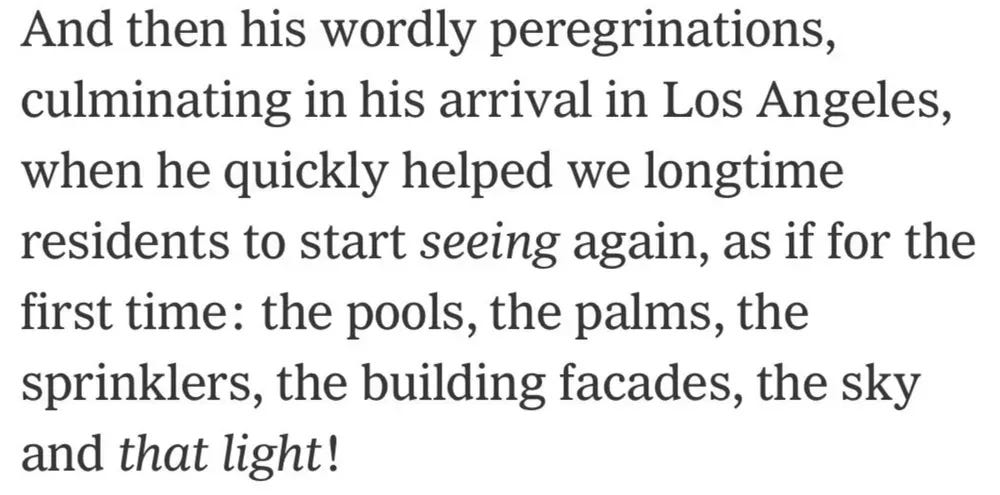
. . . people have had a lot to say about its issues, and you can certainly go back and read through the issues (and the proposed solutions to the issues) in the comments nestling below that post; there’s lots of great, thoughtful stuff there. You people are good at this!
I’ll simply touch now on some of the copyeditorial points that truly captured my imagination, with some commentary on others’ comments.
My friend who forwarded me the paragraph (the rest of the article lives behind a paywall, where I’m happy to leave it) was struck—stricken, even—by that appalling “helped we longtime residents,” and of course that “we” should be an “us.” This barely qualifies as Copyediting 101. It’s more like Copyediting 1.
I immediately thereafter lighted on “wordly peregrinations,” and I’m not quite sure how that even made it to publication, as I can’t type “wordly” without my spellcheck going into aggressive hysterics.1 As to “peregrinations,” that’s a word that perhaps no one needs to hear from anymore, but it’s important to remember that there’s a fine line between copyediting and “I would have written this differently and thus better,” and copy editors need to be careful not to go stomping over it. That said, “travels” is a charming word.
A number of folk have pointed out that the whole slab of text is a sentence fragment, which indeed it is. I don’t have anything in particular against the occasional sentence fragment,2 though this one might easily, by any number of means, have been turned into a full-fledged sentence or sentences, probably for the better.
The collision of “his arrival in Los Angeles” and “when” is driving me (and has driven others) a bit batty, as Los Angeles is not a “when” but a “where.” Big ups to my pal Kian Razi, who was, I believe the first to leap in with “When his worldly peregrinations brought him to Los Angeles, he” etc., which solves the problem handily.
That “quickly” seems to have bugged a few people, and to be honest it was bugging me too. I might have tried to dispose of it with an “AU: UNNEC?”3 in the margin, though I might also, in the midst of taking a hatchet to the rest of the text, have decided to let it go. One chooses one’s battles.
As to “start seeing again,” as always, I caution writers against leaning too heavily on italics, and in as small a space as this I might have opted to let “seeing” simply be “seeing” and reserved the breathless slanting for that climactic “that light,” about which more shortly.4
The colon after “first time” isn’t bothering me. Some people want to repunctuate in the vicinity, by various means, but I’m fine with it as is. Though I’m happy to remind you that fragments/lists, as here, following colons commence with a lowercase letter (as this one correctly does); full sentences following colons should commence with a capital letter, because, y’know, they’re full sentences.
I’m not enthralled with “building facades,” which feels a touch redundant (though it isn’t quite): It’s lumpy rather than punchy, and the other elements here are all single words. But stripping out “building” wouldn’t quite work, I think, particularly because left with “facades” one might be put in mind of the people of Los Angeles rather than the buildings of Los Angeles. I dunno, I can’t fix everything, certainly not at this pay rate.
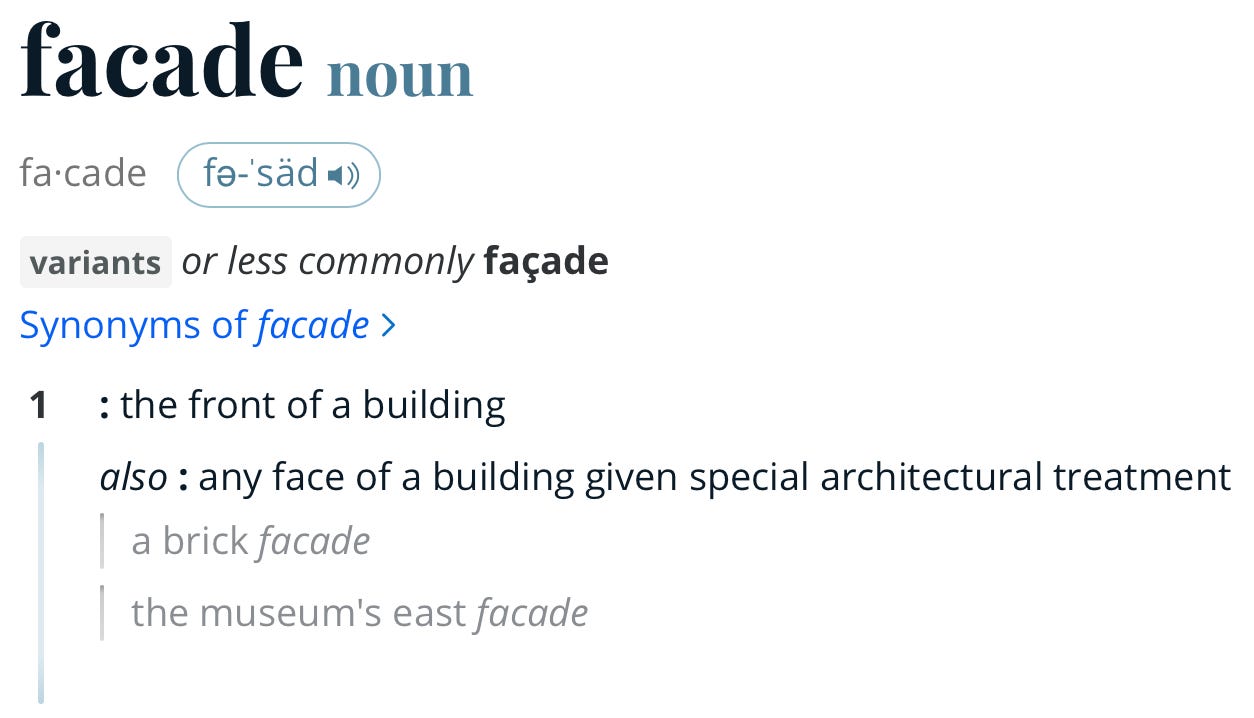
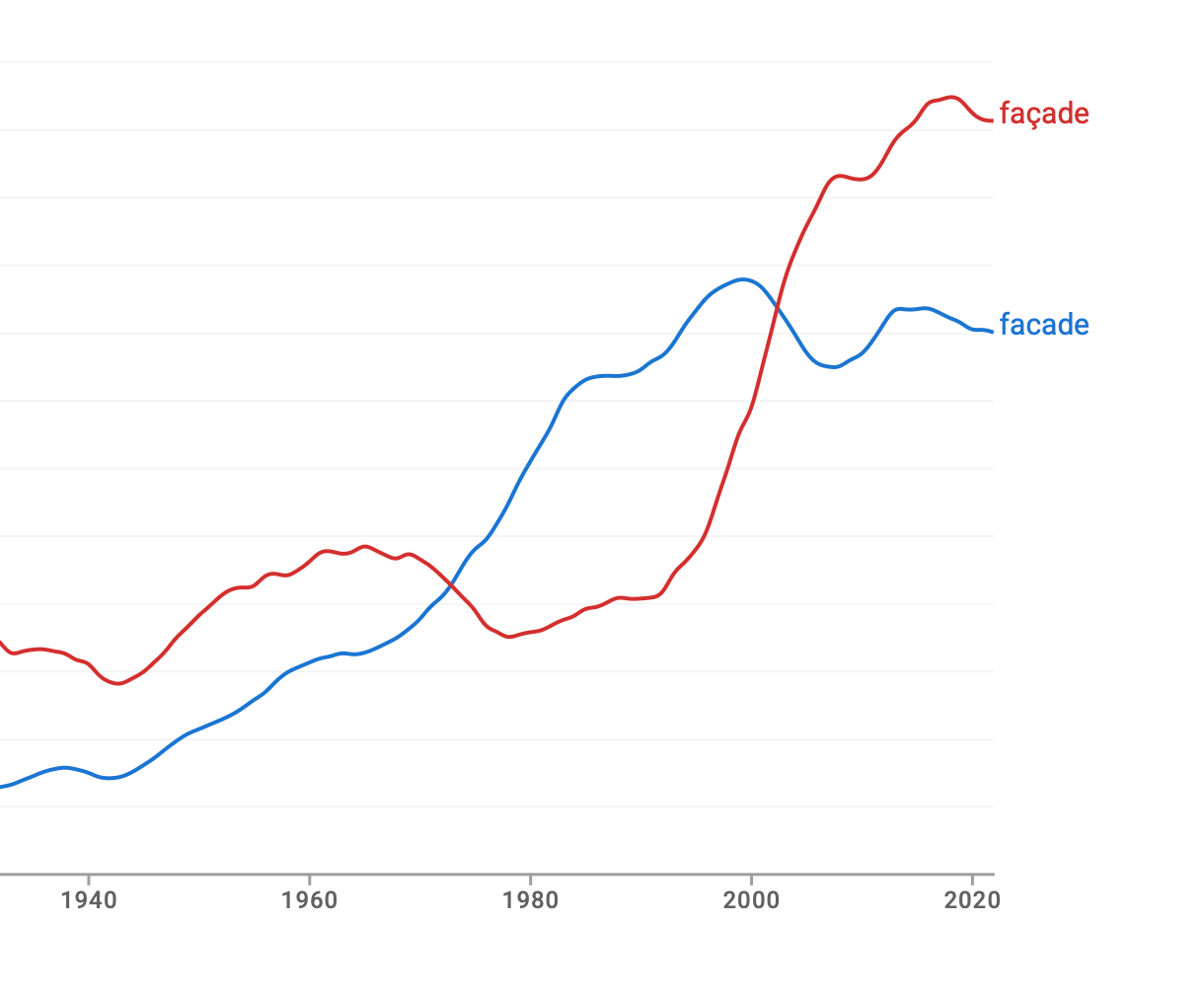
Yes, I prefer my façades with a cedilla.5 So, apparently, do many of you. It’s presumably not New York Times style, and . . .
Neither is the series comma I want to set after “the sky.”
Do we need “and that light”? Might not “and that light” have taken care of it? I’m going with no, and yes.
Last point last: The standard copyediting rule is that we don’t italicize terminal punctuation unless the entire sentence warrants it, but in this case the writer is certainly apotheosizing, specifically, the light—sorry, the light—so this is a rare-ish instance in which such a terminal ! wouldn’t be out of place.
Shoutout to Amy Sedivy, who pretty much solved all the textual problems with the least amount of fuss, thus:
And when his world travels brought him to Los Angeles, he helped us longtime residents to see, as if for the first time, the pools, the palms, the sprinklers, the building facades, the sky. And that light!
Once again, I’m leaving the comments open to all readers,6 because I’m rather enjoying this sense of finger-pointing community. You scamps.
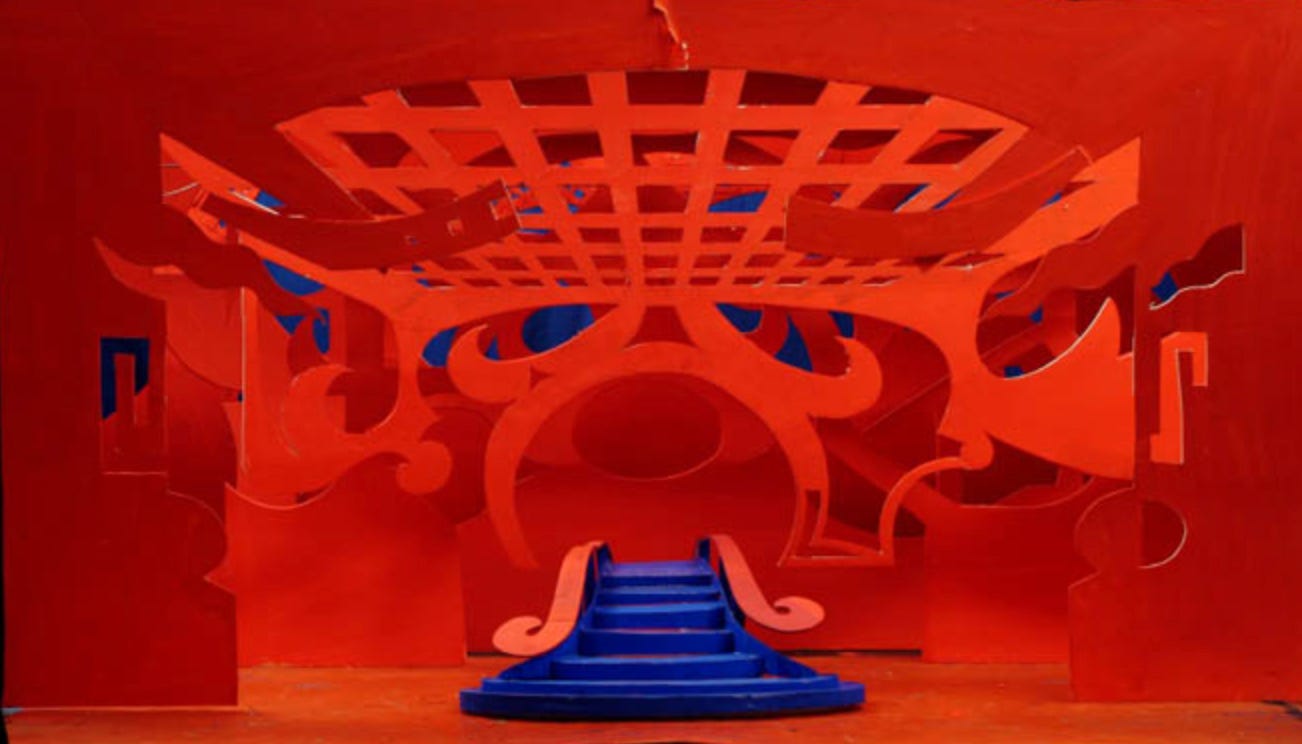
Cover illustration: a David Hockney set design for Puccini’s Turandot, which is the first full-length opera I fell in love with (via recording, that is; I’ve not yet ever seen the Hockney staging except in sketches, stills, and video clips), having shortly earlier fallen in love with the same composer’s one-act Suor Angelica. (The Tebaldi recording of Suor Angelica, my first, remains my favorite. As to Turandot, the Sutherland-Pavarotti-Caballé recording, on which I learned the piece, is, to be sure, spectacular, but you can’t go wrong with Nilsson-Björling-Tebaldi, either. Among others.)
Surely, “worldly” is meant, though there’s something to be said for the notion of “wordy peregrinations,” particularly in this context. Or even “wordy peregrines,” if you like your birds chatty.
Or even bunches of them, as when they’re the opening of Bleak House!
Copyeditorial shorthand for “Author: Is this unnecessary?”
I’m reminded of a friend’s comment about a musical theater performer I love too much to name, though my friend was scarcely inaccurate in his comment, that he, my friend, was quickly exhausted by the performer’s penchant for “hushed wonder.” And that’s what we’ve got going on here, I’d say: a bunch of hushed wonder.
“Less commonly,” our friends at Merriam-Webster assert:
Ahem, I assert:
Comments are usually restricted to paying subscribers. You too could be a paying subscriber! It’s fun!
Two today and no Sallie? Sigh.
Such fun. Thanks!