
"Please tattle to Dreyer"
[a media frenzy]

[Given that today’s missive includes more than a dozen footnotes, I remind you that you don’t have to violently scroll down and up and down and up to enjoy them; you can simply, depending on your particular reading gadget, hover over or click on the superscript numbers and the footnotes will make themselves available to you.]
This morning an online acquaintance forwarded to me, via his largely offline (or at least not-social-media-oriented) wife, a screengrab of a bit of text from The New York Times’s live update feature, which I’ll retype here verbatim (you’ll have to trust me, as I trust my online acquaintance and his wife), as the grab won’t transfer particularly well:
Shamus Roller, the chief executive of the National Housing Law Project was just waking up at his home in San Francisco when he heard that President Trump had cancelled the signing ceremony for the bipartisan bill. “Lot’s of people were starting to celebrate,” he said.
“Please tattle to Dreyer” was the politer1 of the two accompanying exhorting messages from Mrs. Online Acquaintance, so consider me tattled to.
I’m advised by a chum at the Times that their live update feature is indeed a rapid-fire thing and that the house editorial types “are working at lightning speed and trying to check facts, so [mis]punctuation can slip through.”
Fair enough indeed, and we all know what can happen when we’re typing in a hurry, don’t we.2
By the time I was able to double-check the text at the Times site, repairs had been effected:
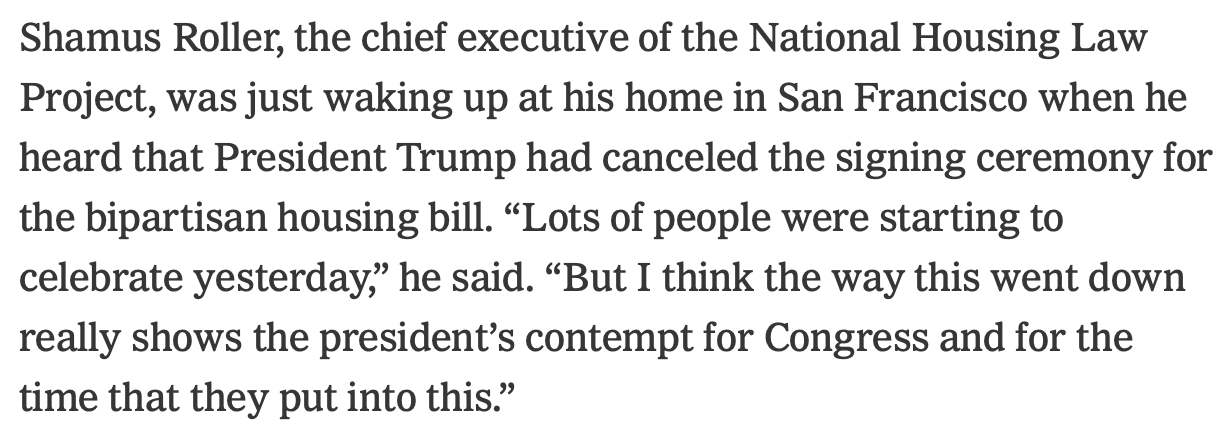
The eagle-eyed among you will note that besides that “Lot’s”3 being corrected to “Lots,” a missing comma had been properly set after “Project,” and, more subtly, someone had belatedly noticed that Times house style favors, as all good Americans ought, “canceled” over “cancelled.”
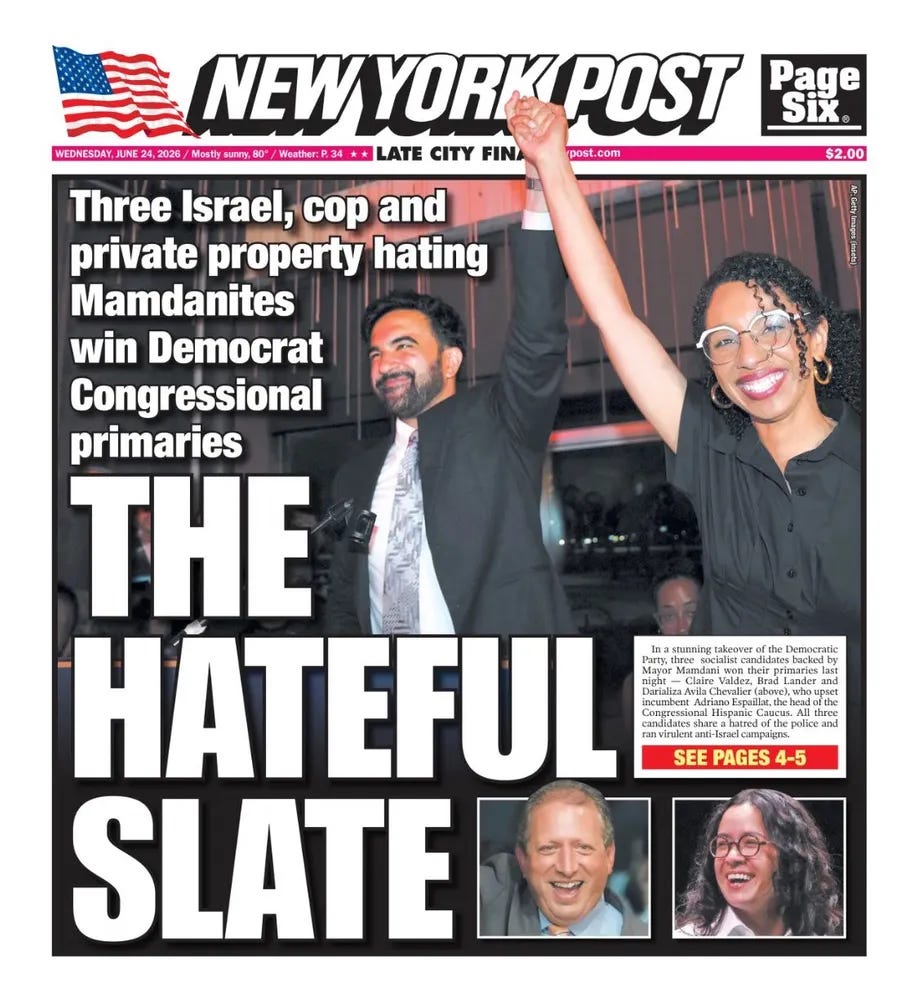
Slightly earlier this morning, another online acquaintance had called my attention to, in that tried-and-true “Stick your nose in this, it stinks!” fashion, today’s New York Post front page:
Ye gods and little fishes.
That subhead should certainly read:
Three Israel-, cop-, and private-property-hating Mamdanites win Democratic congressional primaries4
A, Consider the series comma my gift.
B, As to those two jaunty-looking hyphens after “Israel” and “cop,” they are what we call in the trade suspended hyphens, or suspensive hyphens, or floating hyphens, or dangling hyphens, or maybe even hanging hyphens, and they indicate that a shared bit of follow-up text, in this case “hating,” is shortly to follow. As the fashion people might say,5 such hyphens are very editorial, and they’re nearly as abstruse as my second-favorite piece of punctuation (after the semicolon, that is), the en dash.
C, As to “Mamdanites,” I’m surprised, to be honest, that the Post didn’t opt for “Mamdanistas.”
“Shouldn’t that be ‘Mamdaniites’?” I was asked, and: fair question, particularly, if like me, you’ve always wondered why “Nazism” isn’t spelled “Naziism,”6 but the double i, with which we can and do peacefully coexist in “skiing,”7 would look more peculiar here, I’d say, than it’s worth, and as to the other suggestion that was suggested—“Mamdaniïtes”—well, we leave that sort of thing to certain magazines that like that sort of thing.
D, E, and onward: I pass nearly silently over the adjectival “Democrat,” the traditional feckless right-wing playground insult where “Democratic” is meant,8 and though we do like to refer to the U.S. Congress as “Congress,” there’s no good reason on earth to capitalize “congressional.”
That said, if you glance toward the little bit o’ boxed text to the right, you will indeed see “Democratic Party,” and if you glance a little harder you’ll also see a phantom double space, between “three” and “socialist,” that would have done well to have been halved.9
Also in the news, the artistic director of one of our nation’s leading theater companies announced yesterday:
Our second season is rooted in a simple belief: people10 are hungry for meaningful shared experiences. We have curated11 a collection of shows that invite connection and conversation with the world around us. We want audiences to feel the hum of occasion and the promise of care from the moment they arrive. . . . We hope these productions leave audiences with a deeper sense of truth, a renewed capacity for wonder, and a fuller connection to the heart of our shared humanity.12
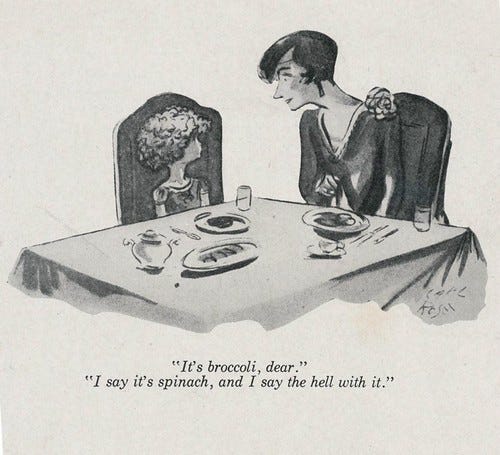
As disinclined as I am to blame this sort of fatuous gurgling on poor put-upon bots when it can just as easily be blamed on incompetent human endeavor, AI aficionados of my acquaintance suggest to me that this particular prose sample carries the heavy whiff of being bot-driven, if not fully bot-composed. Well, I say it’s spinach, and I say the hell with it.13
Lovely to see you, as always. I extend, as always, my gratitude to those of you who have chosen to subscribe to this series, and to those of you have become paying subscribers, with no greater benefit than to be able to comment in the comments,14 I am particularly grateful.
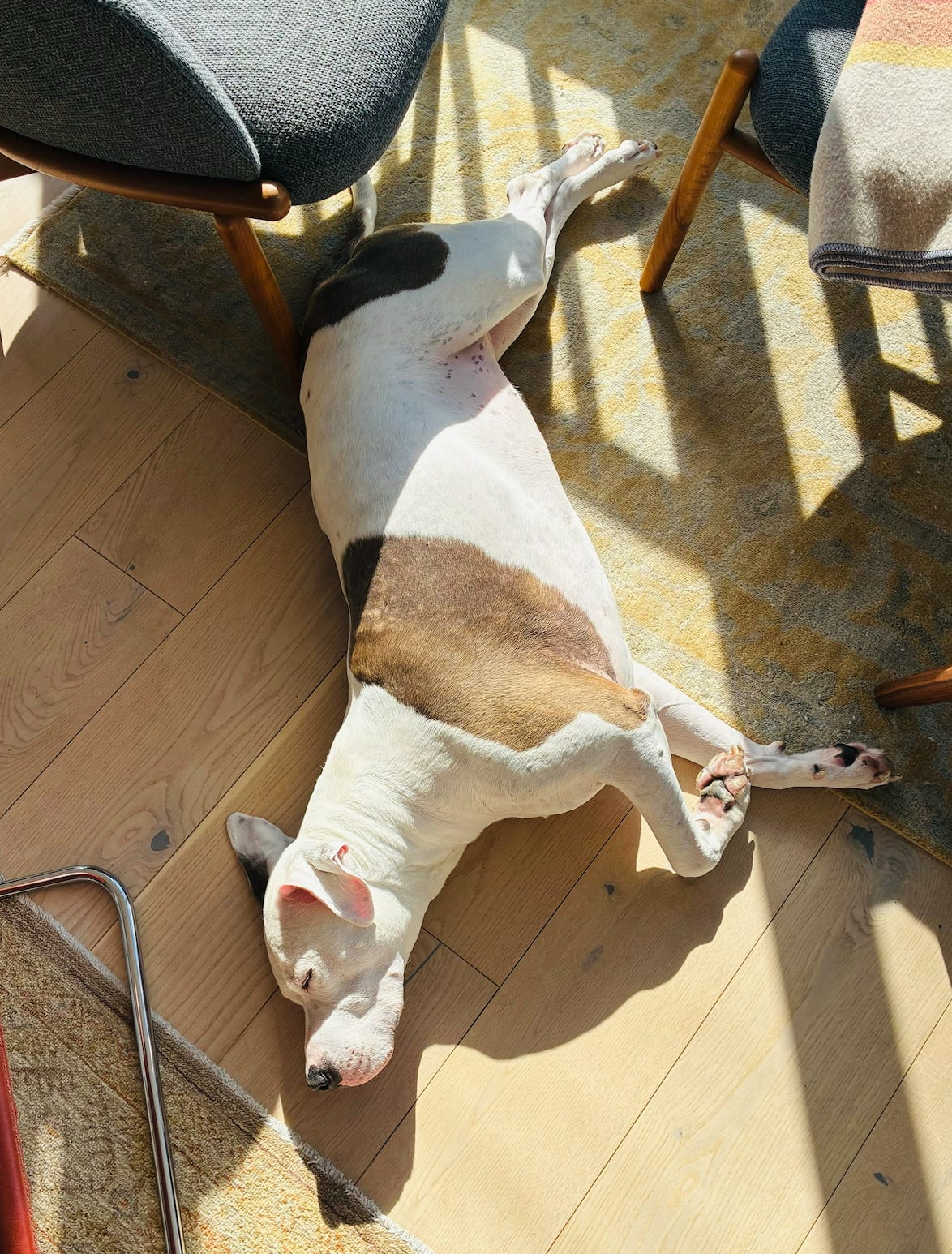
Sallie is grateful as well.
Till next time,
B.
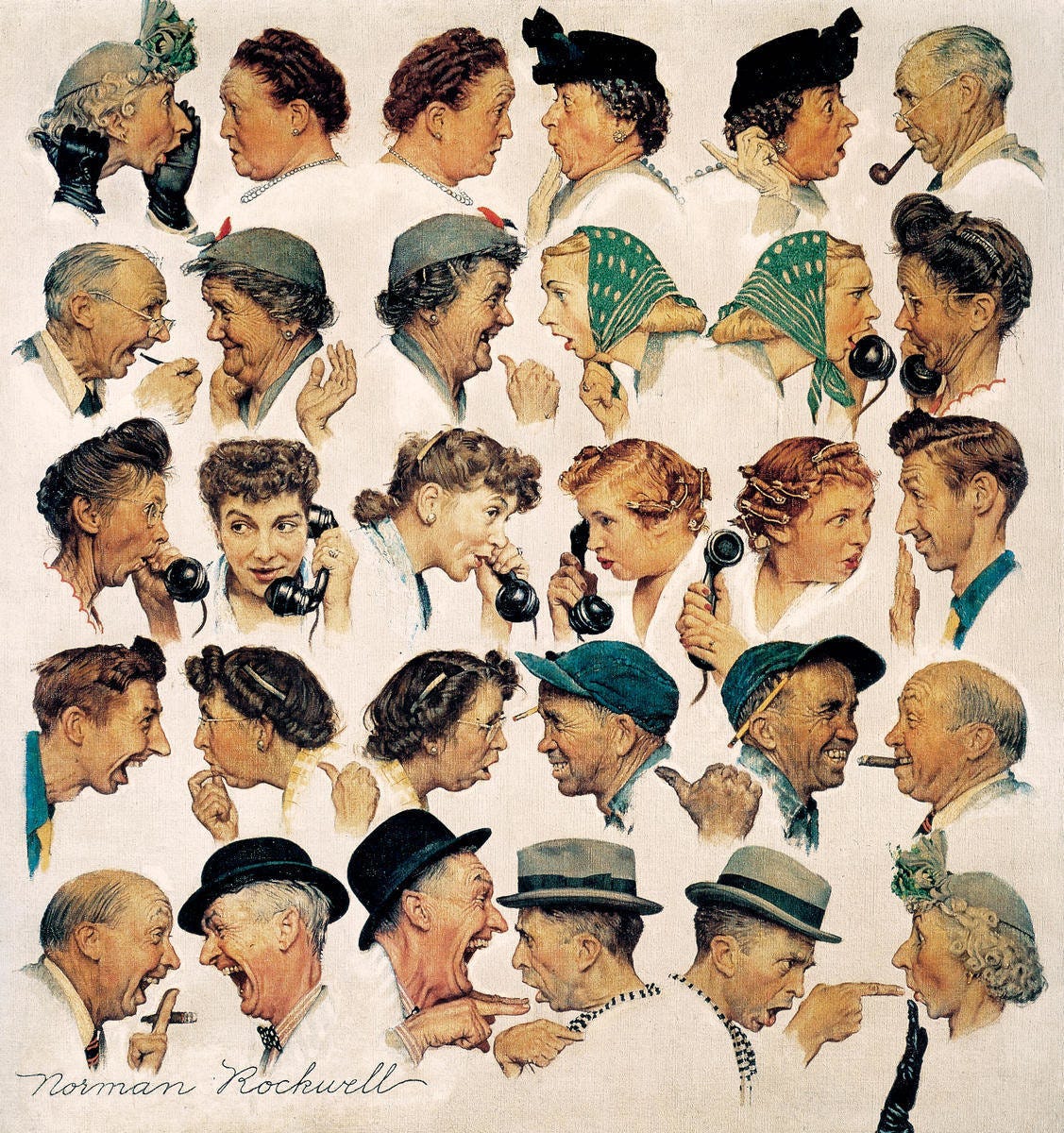
Cover painting: Norman Rockwell, The Gossips (Saturday Evening Post cover, March 6, 1948)
And nonobscene.
As indeed I have just relearned the hard way, as some of you may already be aware/have noticed, though I have no intention of, beyond this footnote, ratting myself out publicly/explicitly. As always, the best time to catch a typo is immediately on publishing something.
Hurry or not: yikes.
As a friend quipped: “An Israel, a cop, and a private property walk into a bar . . .”
Or at least they said it a lot on Project Runway when I was still watching Project Runway.
The double-i spelling is scarcely unknown; it just didn’t especially catch on.
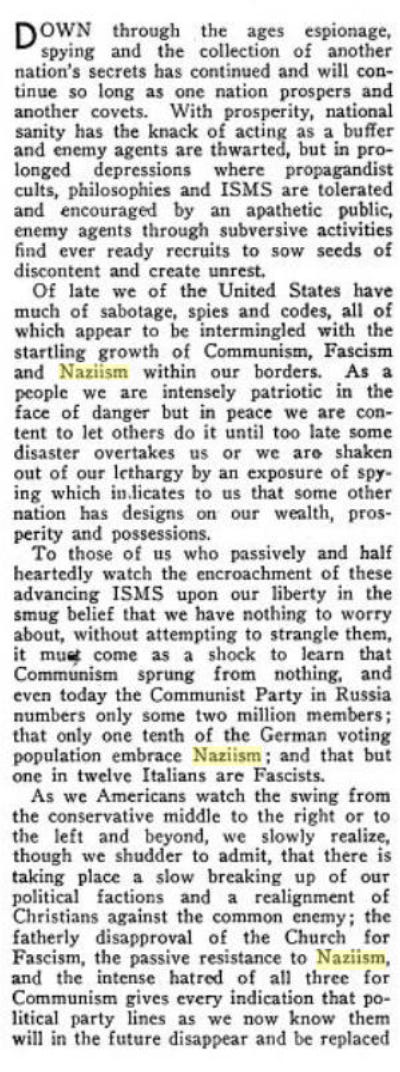
There are scores and scores of words including double i’s, but nearly all of them are extremely peculiar and rare. The only other one that sprang, after a while, to my mind was “radii,” though that doesn’t quite count in the present discussion.
Post-publication addendum: I’m reminded as well of “Hawaiian” and “torii,” which I’ve been known to play a lot in Scrabble even though I don’t know what it means. I suppose I should look it up some day.
Perhaps we should start calling the Republican Party “the Republic Party.” Oooooh, that’ll get ’em.
Such things tend to creep in when text has been edited late in the game (one reason to always do a search-and-replace for double spaces in whatever it is you’ve been working on before you hand it off to whomever). Perhaps the Post started out calling them commies before they lowered the temperature to socialists. 🤷🏻♂️.
The first word of a complete sentence commencing after a colon should itself commence with a capital letter, but there are far more rotted fish to fry here.
Yes, again, the whole thing is awful, but this sort of “curated” thing is always a stick-poke in the eye. “We hates it, we hates it, we hates it forever!” as someone once said.
I find myself fixated on the fact that a theater company with vast resources that is perhaps uniquely capable of producing revivals of great American works like, say, Sidney Kingsley’s Dead End or Elmer Rice’s Street Scene (or the Kurt Weill musical based on it) (or both, in rep) is instead reviving A Few Good Men and The Sound of Music.
Oh, how I adore this cartoon.
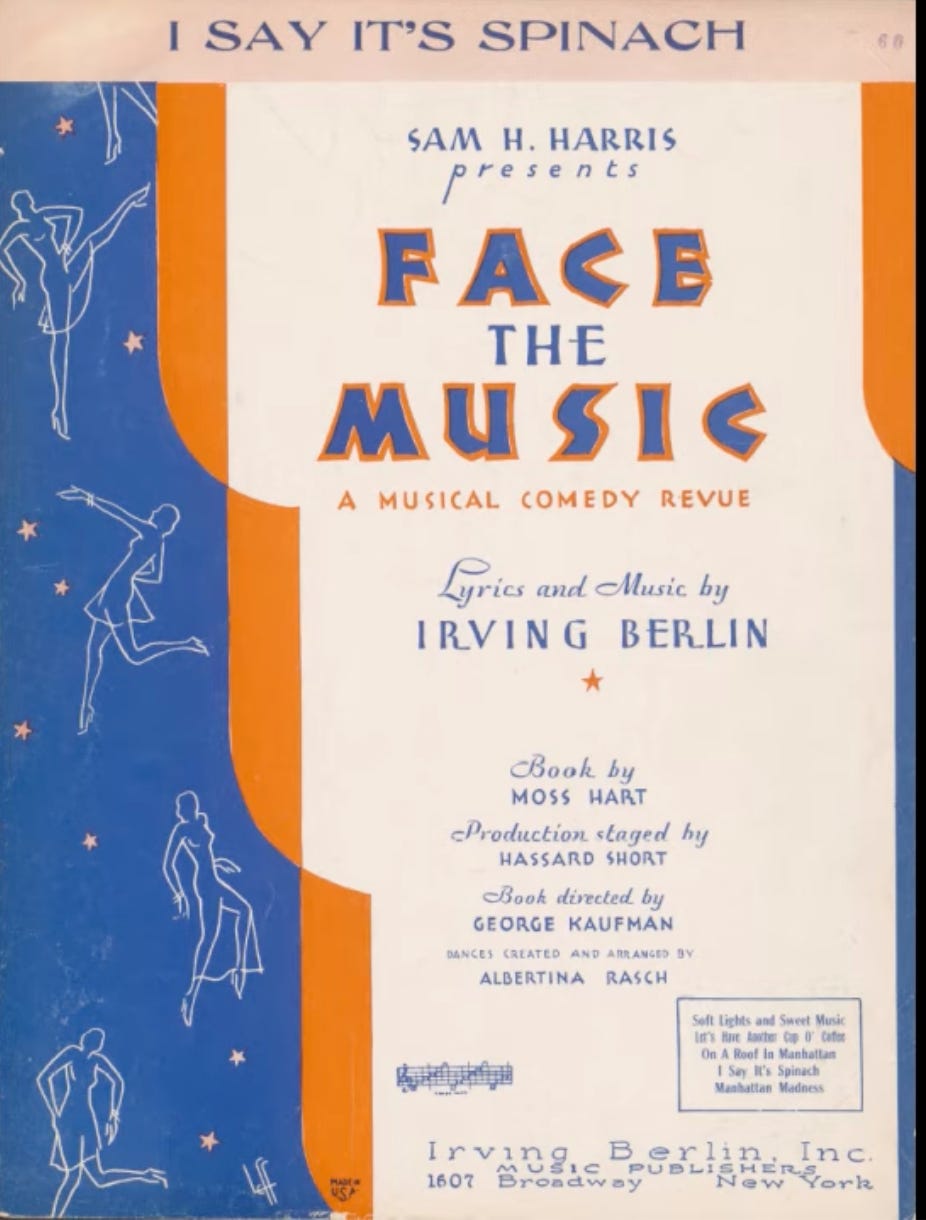
And by all means, please tattle to Dreyer. The lines are open.
As a general rule, I would prefer bot-omized to bot-composed. Might be just me though.
As a former Artistic Director at a locally-recognized and regionally-suspected theater company (and an even-more-former dramaturg at a much larger place), I can report that this kind of prose, alas, predates bot culture. I once proposed a "Platonic Marketing" campaign, along the lines of: Six Good Plays (Three of them Great), and Here's Why You Might Want to See Them.... (capital letters for typographic notice, not correctness). It was not adopted.