
Say what?
[a pronunciation digression]

[Given that this missive includes nearly a dozen footnotes, I might do well to remind you—as I like to do periodically, and it seems to have been a while—that you don’t have to violently scroll down and up and down and up to enjoy them; you can simply, depending on what sort of machine you’re reading on, hover over or click on the superscript numbers, and the footnotes will make themselves available to you.]
The other day I found myself listening to—listening to, mind you, not even watching; don’t, perhaps, ask—Little Miss Alice Faye performing “The Polka Dot Polka,” from Busby Berkeley’s deliriously deranged 1943 Technicolor spectacular The Gang’s All Here,1 and found myself in the midst of a momentary panic over Faye’s pronounced pronunciation “pol-kah,” with indeed an l definitively shoring up that first syllable.2 Because it occurred to me that in all my many years, though not entirely certain I’d ever said the word aloud (I mean, it doesn’t much come up), I’d had it in mind that the word is pronounced “poke-ah.”3
Off I ran to my online dictionary of choice, one of whose perhaps underrated miraculous features is that it will, with the click of a cursor, actually talk to you,4 which comes in extremely handy if you’ve never learned to read those phonetic do-jammers with which printed dictionaries festoon themselves and also can’t, like me, tell a schwa from a Swatch watch.
And thus I learned that one may, if one is so inclined, pronounce the l, and one may also, if one is so disinclined, skip it.5
Neither with cool-eyed copyeditorial professionalism nor with an amateur’s verve do I police anyone’s pronunciation of anything unless it’s my own—to paraphrase Professor Higgins, I don’t care what you say, actually, as long as you spell it properly—but after getting the polka thing nailed down I was happy to remind myself, simply for my own edification, that one does not pronounce the l in salmon, and that one may pronounce the l in yolk but probably shouldn’t. (As to the controversial central t in often, you may do as you like; I’d rather die than utter it.)
Speaking of uttering, and of central t’s, and of pronunciation generally, I’m reminded that as a theater-inclining freshman at Northwestern University, I took a required class in articulation taught by a marvelous professor named Bonnie Raphael, who in a matter of months managed to bleach my voice of its overbright Long Island shades, get it out of my nose, lower it considerably,6 and inspire me to pronounce those central t’s in words like utter, butter, and mutter that had, for me, previously been lumpy glottal stops.7
The point, to be sure, was not to rob any of us in the class of personality but to provide us with a neutral palette, to say nothing of a neutral palate, that could be recolored and enhanced for uses besides sounding, more or less, like network newscasters.8
I particularly cherish one point of instruction when I was called upon to pronounce, reading from some bit of sample prose, the word “human.”
Which I did. Or thought I did.
“‘Human,’” Professor Raphael said, halting me dead in my tracks. Perhaps she winced. “With an h.”
“That’s what I said,” I recall myself saying. “‘Yoo-man.’”9
“Indeed that is not what you said. It’s ‘h’yoooo-man.’”10
And somewhere in the distance a great bell went clang, a lightbulb illuminated itself over my head, and we all launched into “The Rain in Spain.”
And thus I finally, at age seventeen or so, learned to talk good.
Thank you for dropping by, and I hope that you’re having a lovely Sunday. I extend my appreciation to those of you who have subscribed to this series of mine, and to those of you who have stepped up to become paying subscribers, with no particular reward (beyond my gratitude) than the ability to chitchat in the comments, I am deeply, especially grateful. You help keep the lights on in all sorts of ways, and it makes a difference.
Also especially grateful: gimlet-glancing Sallie.
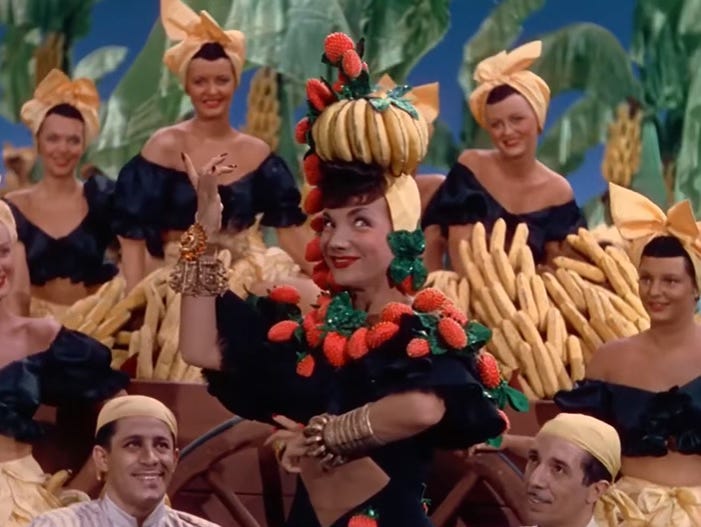
Cover image: Carmen Miranda, as Dorita (though, whom are we kidding, as Carmen Miranda), performing “The Lady in the Tutti Frutti Hat” in The Gang’s All Here. As long as we’re discussing pronunciation, it is, I’d say, Miranda’s exquisite diction that makes her fractured English shtick as funny as it is. Also, the entire movie is a treat,11 and if you’ve never seen it, or haven’t seen it in a while, I can think of few better ways to while away a couple of lazy Sunday hours.
P.S. Apropos of nothing in particular besides my desire to help you be happy, my friend Liz Callaway has just released a new album, The Wizard and I: Liz Callaway Sings Stephen Schwartz, and it’s exquisite from tip to toe. (Probably my favorite track is Liz’s wry, moving performance of “West End Avenue,” from The Magic Show, though that’s perhaps at least in part because it’s long been one of my favorite theater songs.) You should give it a listen!
By the bye, the melody of the 1917 song “The Gang’s All Here” (as in “Hail! Hail!”), which we hear briefly in Berkeley’s film, over (under?) (alongside?) the credits, was lifted (with, happily, credit to composer Sir Arthur Sullivan) from “With Cat-Like Tread,” from the 1879 comic opera The Pirates of Penzance (which song itself tips its hat, with the absence of any credit at all beloved of parodists, to the so-called “Anvil Chorus” from Verdi’s 1853 Il Trovatore). If you’d like to treat yourself to a treat, do check out the cast recording of my BFF Rupert Holmes’s recent New Orleans–set* rejiggering Pirates! The Penzance Musical, which of course includes the big hit tune, with, as a bonus, a particularly and, I think, hilariously Holmesian lyrical nod to the later song that I won’t spoil here. To say nothing of, in a different number, the lunatic couplet “We’re not fragile capodimonte, / Just as agile as the sisters Brontë,” which induced me to guffaw the first time I heard it. And the second and third times.
*En dash alert!
Y’know, the way it’s spelled. Just to state the obvious.
Or, if you will—will you?—“po-kah.”
Don’t forget to turn your volume up.
Sharing this nugget of information with some online pals, I was amused to note, in response, repeated variations on “I pronounce the l for the dance and skip it for the dot.” (You can, to be sure, read up, at your leisure, on the historical intersection of the dance and the dot.)
I have never forgotten her instruction in this regard, and you should try it too! Sing your way down the scale as absolutely low as you can go, then sing back up five notes, and that’s your optimal speaking pitch, with which you can be heard more or less across a crowded room without shouting, and with which you can talk and talk and talk and talk without wearing your throat out.
Though it’s tricky to pronounce those t’s without sounding each and every time as if you’re pointing at your own mouth with both index fingers, I can still manage the task with reasonable subtlety if, paradoxically, I concentrate very hard. Also, I think it’s objectively hilarious that the word “glottal” includes that central t sound that, skipped, makes the word sound like the noise Cream of Wheat makes on the stove if you don’t turn the flame down.
I do particularly recall a key exception to the generalized neutrality: One always pronounces people’s names the way they pronounce them and want them pronounced. There was, and is indeed, a lesson there.
This is not, I think, an uncommon pronunciation among New Yorkers, of which I was and probably, at least in some ways, always will be. That said, I’m pretty sure that I’d learned by the time I got to college that a twenty-five-cent piece is not, as I’d spent my youth calling it, “a kaw-tah.”
To be sure, Cole Porter’s “now, gifted humans like Vincent Youmans” works as a legitimate rhyme, and not as what’s generally referred to as an identity, or rich, rhyme, only if you appreciate that “humans” and “Youmans” are not homophones.
Charlotte Greenwood klaxon!
I come from the Land of Lawrence Welk, the very king of polka, and the “l” was always pronounced … I schwa.
And Sallie, that skeptic side-eye, one too many verses of “Yes, We Have No Bananas”?