
It's today!
[a centenary celebration]

In honor of what would have been the 100th birthday (it’s today! October 16, 2025!1) of the divine Angela Lansbury, here’s one of my favorite little bits of text magic:
In Christopher Bond’s superb 1970 guignol Sweeney Todd: The Demon Barber of Fleet Street, the inspiration and source2 of Stephen Sondheim and Hugh Wheeler’s titanic 1979 musical of, as they say, the same name, the pie maker Mrs. Lovett, in narrating the fate of poor Lucy Barker, the wife of the quondam Benjamin Barker, unjustly arrested and transported to Australia and now, self-reinvented as Sweeney Todd, surreptitiously returned to his native London, notes that in the aftermath of her husband’s abduction, Lucy—terrified, abused, distraught—“went straight up where Johanna”—the Barkers’ daughter, that is—“was sleeping and woke her up. Then she gave the poor mite poison and took the rest herself.”3 Adding, to helpfully clarify the situation: “It was just your wife that died.”
In the musical—and I don’t know if this was Sondheim’s idea or Wheeler’s, but it’s a stroke of genius, whoever’s stroke it was—Mrs. Lovett says only, “She poisoned herself. . . . I tried to stop her but she wouldn’t listen to me.”
How fast on her feet she is, how cunning. Because, as we eventually learn, Lucy is (sorry, spoiler) not dead; she’s survived as, as the sailor Anthony characterizes her when she makes her first appearance in the musical’s opening moments, “a half-crazed beggar woman.” (We realize who she truly is sooner or much later, depending on how clever we are and how carefully we’re listening to Sondheim’s musical clues; I don’t think I got it, my first time out, till the last possible second.)4
Which leads us—again, in the musical version—to, amid the tragic revelations of the final blood-drenched scene:
TODD: You lied to me.
MRS. LOVETT: No, no, not lied at all. No, I never lied. Said she took the poison—she did—Never said that she died—
It’s such a gruesome, gorgeous twist.
Full-out lie or self-serving quarter-truth, it doesn’t (sorry, spoiler) end well for Mrs. Lovett.
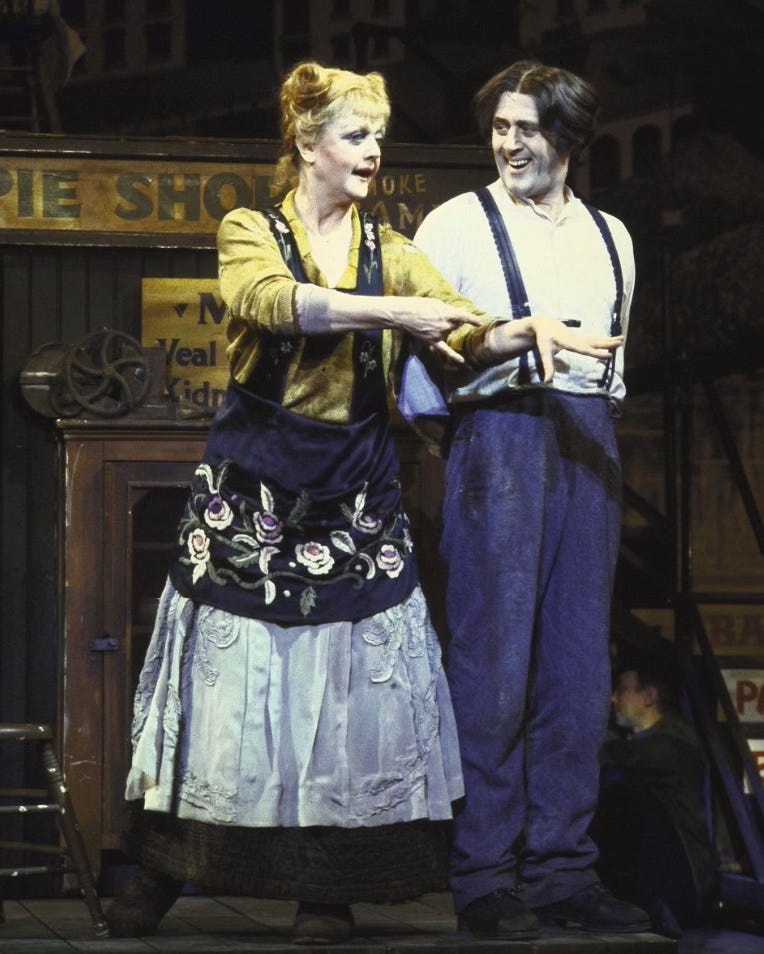
I was fortunate enough to see Dame Angela nine times live and in person, including, our first encounter, in the 1974 revival of Gypsy and, twice, in Sweeney Todd (the second time at an airplane hangar of a barn in Chicago that, with some 4,000 seats, is more than twice the size of the airplane hangar of a barn in which the show premiered in New York, and let’s just say that Angie playing full out to that 4,000th seat was an awful lot of Angie playing full out), and, particularly delightfully, in a 1990 benefit concert in London in which she and Bea Arthur5 re-created their epic “Bosom Buddies” duet from Mame.6
But I can also recall that I saw her in a 1982 flop called A Little Family Business, of which I can, in truth, recall absolutely nothing except that I saw it and that the stage lighting was blindingly overbright, and, in 2007, in a negligible bit of drab piffle called Deuce,7 in what turned out to be the last complete Dreyer family theater party (even my father, famous for not attending things, attended), and which at the time one thought might be Lansbury’s theatrical swan song, though as it turned out she was just getting warmed up for a late-career renaissance that included her cavortingly daffy Madame Arcati in a 2009 revival of Noël Coward’s Blithe Spirit, which I attended with my Robert, who ever afterward referred to her, with keen affection, as The Old Lady.8
In any event, she was a miracle, that Old Lady, and we were lucky to live in her era.9
Some Personal, As They Say, News
Along with writer Ling Ma and Chicago Public Library superstar Stephen Sposato, I’m to be one of the three judges of the 2025 Story Prize, and I’m extremely honored and psyched about that.
Toward the end of this current month—Sunday afternoon/evening, October 26, to be specific—I’ll be offering an intense two-hour online intensive on Being Your Own Best Editor via the lovely folk at Five Things I’ve Learned, and perhaps you’d care to join me for that.
On Monday evening, November 10, I’ll be in conversation, at Book Soup in West Hollywood, with the masterly Dan Chaon to celebrate his eerie, spooky, enchanting new novel, One of Us, and perhaps you’ll be there too, if you’re in the neighborhood. In the meantime, here, linked, is a fascinating conversation between Dan and my pal Lincoln Michel.
On December 15 I’ll be at the Ebell of Los Angeles Lounge with the lovely and talented Kerry O’Malley and Annabeth Gish for, courtesy of Writers Bloc Presents, In the Night. In the Dark. An Evening of Shirley Jackson Readings. This is going to be, if I say so myself, too much fun, and, really, you should just get your tickets now before it sells out. (I’m keeping the program—in honor of SJ’s birthday, which is the 14th—a secret till night-of, but let’s just say that there’ll be two full spooky stories and one haunting excerpt.)
Well, that’s enough for today, and I haven’t even gotten around to singing the praises of my newly arrived copy of the Twelfth Edition of Merriam Webster’s Collegiate Dictionary, so I’ll just do that picture-is-worth-a-thousand-words thing—in truth, that two-pictures-are-worth-two-thousand-words thing—and what better way to sing the praises of a dictionary. Except to say: This volume is beyond gorgeous.


I thank you for being here, and, as always, I particularly thank those of you who’ve subscribed to this series of mine, with particular particular thanks to those of you who’ve gone above and beyond and chosen to support this endeavor financially, with no better tangible reward than the ability to chitchat with me in the comments section. It truly makes a difference, on lots of levels, and I’m extremely grateful.
Sallie is grateful too!
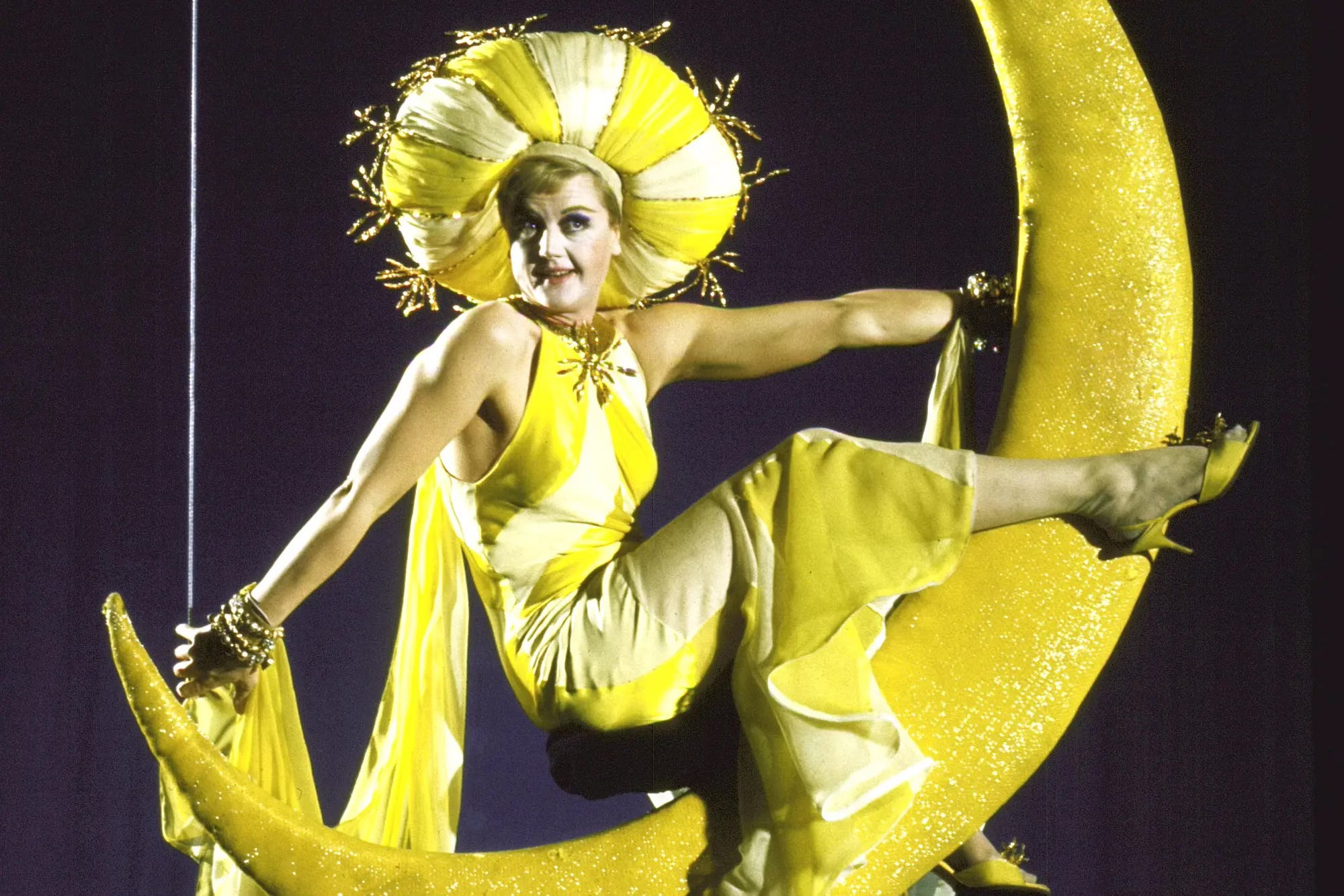
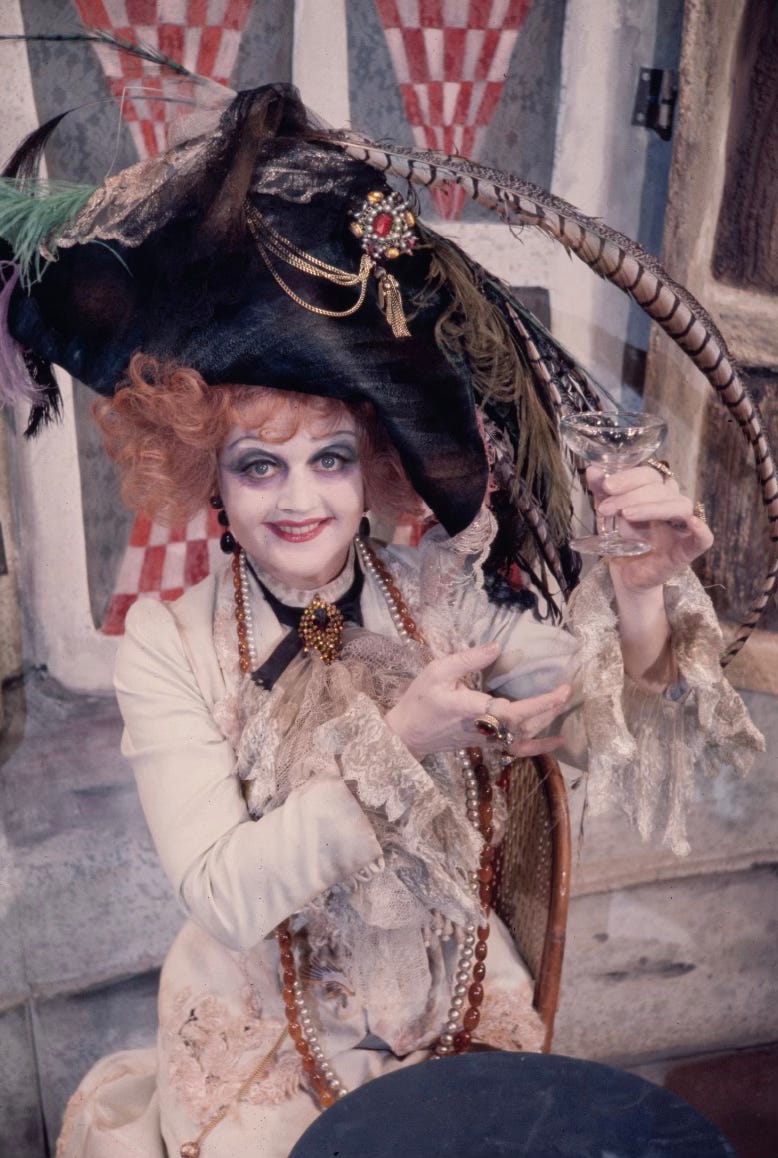
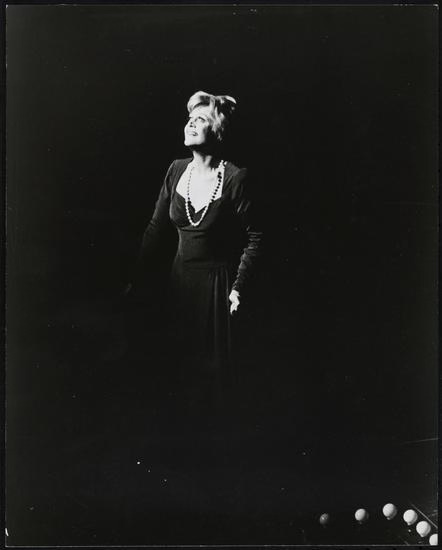
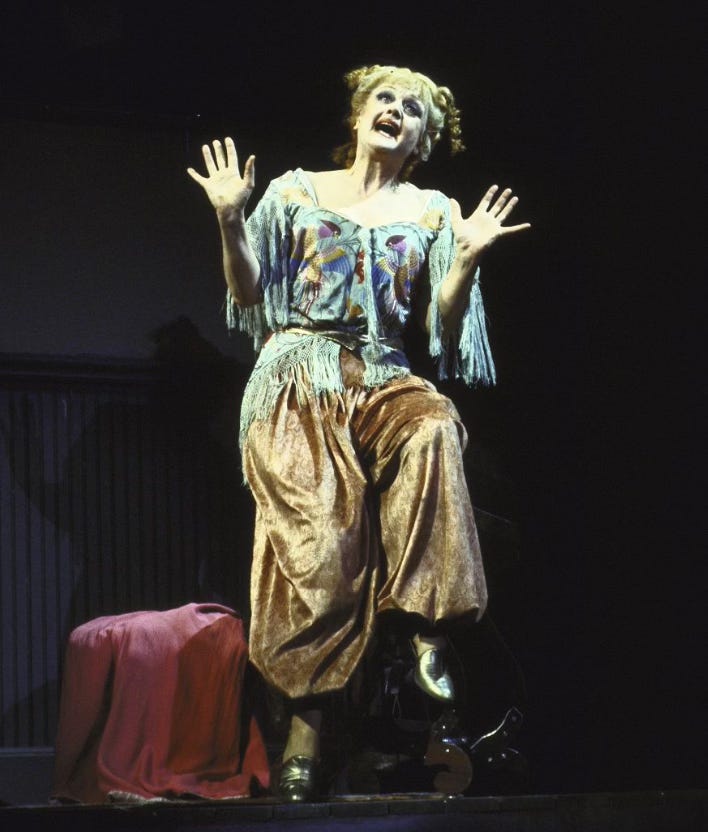
Cover photograph: Angela Lansbury in Mame (1966)
Or, as one says almost everywhere except in the United States, 16 October 2025.
How close a source? The play’s opening line, from the sailor Anthony, is “I have sailed the world.” And here’s a bit from Mrs. Lovett’s first speech:
I only took you for a ghost ’cos you’re the first customer I’ve seen in a fortnight. . . . You’d think we had the plague, the way people avoid this shop. . . . Mind you, you can’t hardly blame them. There’s no denying these are the most tasteless pies in London. I should know, I make ’em. (She puts the pie on the table, then flicks a bit of dirt off the crust.) Ugh! What’s that?
If you know the musical, you’ll appreciate here—and it happens any number of times over the course of the twin scripts—how deftly Sondheim plucks up Bond’s text and makes gruesome poetry out of it.
As long as we’re down here in the footnotes, a reminder that if you want to type a word that begins with an apostrophe—as, here, ’cos and ’em—I find that the easiest method is to type, for instance, x’cos or x’em and then delete the x, leaving you with ’cos rather than (no!) ‘cos and ’em rather than (no!!) ‘em. There are, to be sure, other methods, but I like mine (and can remember it).
One is occasionally told never to use more than two em dashes in a sentence. One should not always listen to everything one is told.
Also, that is a really long sentence up there. 🤷🏻♂️.
I’m not a great one for solving whodunnits before All Is Climactically Revealed, though I’ll always pat myself on the back for, attending Sidney Lumet’s delectable 1974 film of Agatha Christie’s Murder on the Orient Express, fairly quickly deciding (sorry, spoiler) that if more than one of the train’s uberglamorous, semiglamorous, and Ingrid Bergman–ous* passengers Did It, as was manifestly the case, then all of them Did It. Mysterywise, it’s pretty much been downhill for me from since then.
*En dash alert.
A particularly merry recollection: Bea Arthur so spectacularly underunderplaying the line “If I kept my hair natural like yours, I’d be bald” that she barely uttered it—virtually a homeopathic delivery—and the house falling all over itself with thunderous laughter.
I have quoted this passage—by the critic John Mason Brown on a failed 1949 Katharine Cornell play titled That Lady—at least twice in this series, but I quote it a lot, so one more time, before the next time, won’t hurt:
It is not pleasant to have to write such words about any production offered by people in whose debt our theatre stands so deeply. We, the non-creative public, are all too apt to forget that artists are entitled to their mistakes. In the arts the wonder is not that lightning does not strike again and again but that it ever strikes.
Robert likes to rename people and things; it’s one of his little whimsies (one of his handful to my accumulated steamer trunkful). The 1980s Mapp & Lucia series, on which he dotes almost as rabidly as I do, is “Mr. Georgie,” Arrested Development is “Orange County,” and Stockard Channing, because somehow he could recall that my chums and I had a nickname for her (it’s the obvious, militantly unsubtle one I’m sure you’ve already figured out) but couldn’t recall what precisely it is, has become, of all things, “Socks.” Which I now call her half the time too.
No one needs me to tell them to watch Gaslight or The Manchurian Candidate, but if you want to check out some superb Angela film work in not the usual suspects, do look for The Dark at the Top of the Stairs, The World of Henry Orient, and Dear Heart (utter goop, with Geraldine Page at her most fey, which is saying something, but peculiarly irresistible, and Angela is marvelously, welcomely astringent, plus it features both Mrs. Kravitzes, Alice Pearce and Sandra Gould, and what are the odds).
Albert Finney as Hamlet -- in 1975? Had to look that one up. “There is obviously a lack of light and shade in a Hamlet who sprints onstage like something out of ‘The Seven Samurai,’ starts brandishing a dagger beneath his chops and delivers ‘To be or not be’ as if it were a last‐ditch decision against hara‐kiri. And yet there's no doubting the urgency and impact of such an approach. Mr. Finney constantly rivets the eye and ear.” https://www.nytimes.com/1975/12/24/archives/praise-and-scorn-for-london-hamlet.html
Now this is the kind of distraction I need. Thank you for making me chortle today. And for the foray into Lansburian history. Loved it!